
Make the renderer editable
The current workspace has a scene hierarchy, viewport, material assets and component inspector. Primitive creation, object selection, transforms, grouping, undo and saved cameras turn the material lab into an authoring workflow. Versioned scene files retain geometry, materials, camera views and optional stage settings.
Build a scene with motion and light
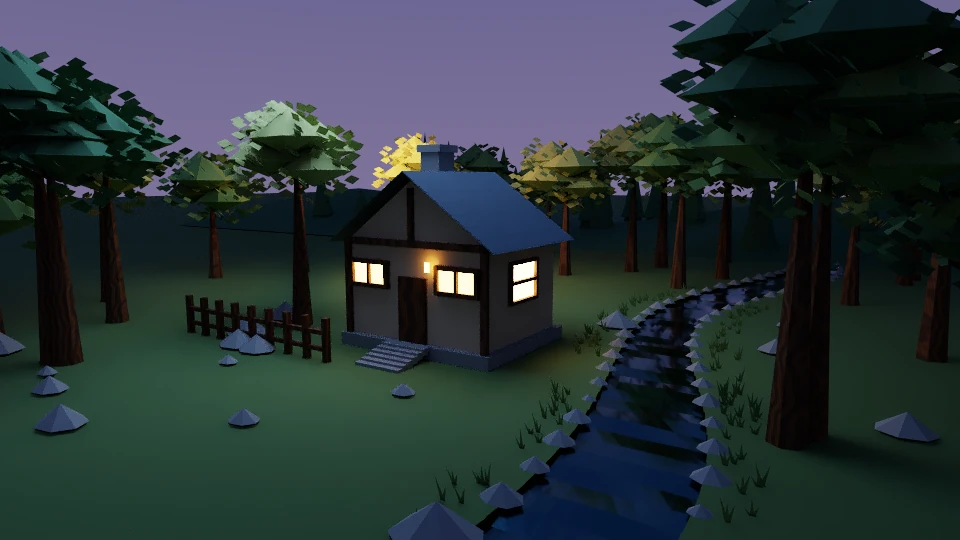
The woodland cottage preset combines window lighting, moving foliage, a flowing stream and an authored camera shot. Triangle meshes use a bounding-volume hierarchy; fixed-topology animation can refit it. Spatial denoising and weighted stage-light selection help make the scene practical to inspect.
Retain the limits with the result
The retained September 13 validation record reports 50 CPU and 45 browser tests plus the production build. The companion movie frame was rendered September 12 at 64 samples per pixel before the subsequent geometry optimizations. It is an engine render, not a real-time frame-rate demonstration. Asset-file import, reusable assets, instancing, UV mapping and a full game runtime remain future work.
What I learned
A renderer needs reproducible scenes as much as attractive images. Keeping source snapshots, test fixtures and capture settings makes it possible to tell an editor improvement from a transport regression or an unfair performance comparison.
Sources & development context
Twizel Engine README; docs/editor-workspace.md, scenes.md, woodland-stage.md, geometry.md and godot-performance.md; retained validation 2026-09-13T00-51-57-401Z. Image: Twizel's own 64-spp cottage shot, 2026-09-12T19-57-17-991Z-hardware-requested, frame-00000.png. No Godot comparison image is used as Twizel output.