
The glow that looked like wood
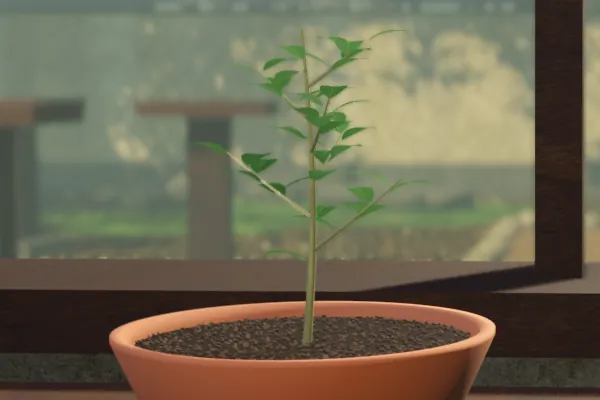
On the second look, a cut stub seemed to be sucked into the trunk: a pale funnel where the stub met it. I made the smooth blend between branch and trunk keep the trunk's bark until close to the branch, as a real branch collar does, and showed the frame before and after. The answer on the third look was "this update looks exactly like the previous one, i don't see any difference at all". It did look exactly the same, so the real question was what the pale shape was.
A new check renders that frame three ways: as drawn, with every branch collar hidden, and with nothing selected. With the collars hidden, the pale shape was still there, so it was not the collar. With nothing selected it was gone, and the junction showed the trunk's own olive-grey bark. The pale funnel was the selection highlight.
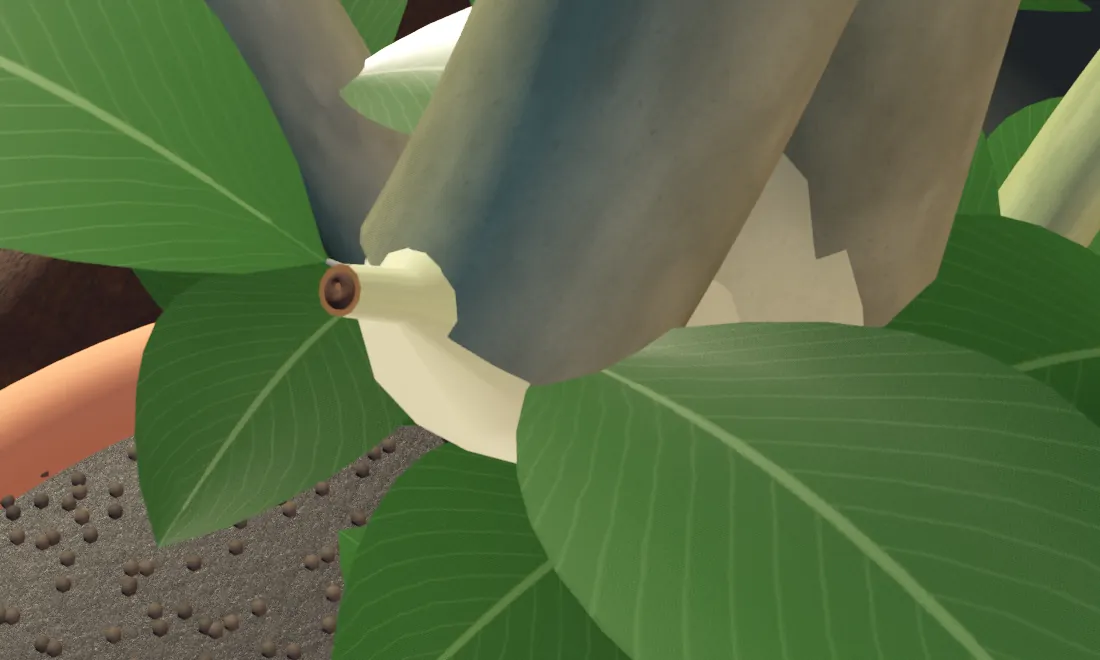
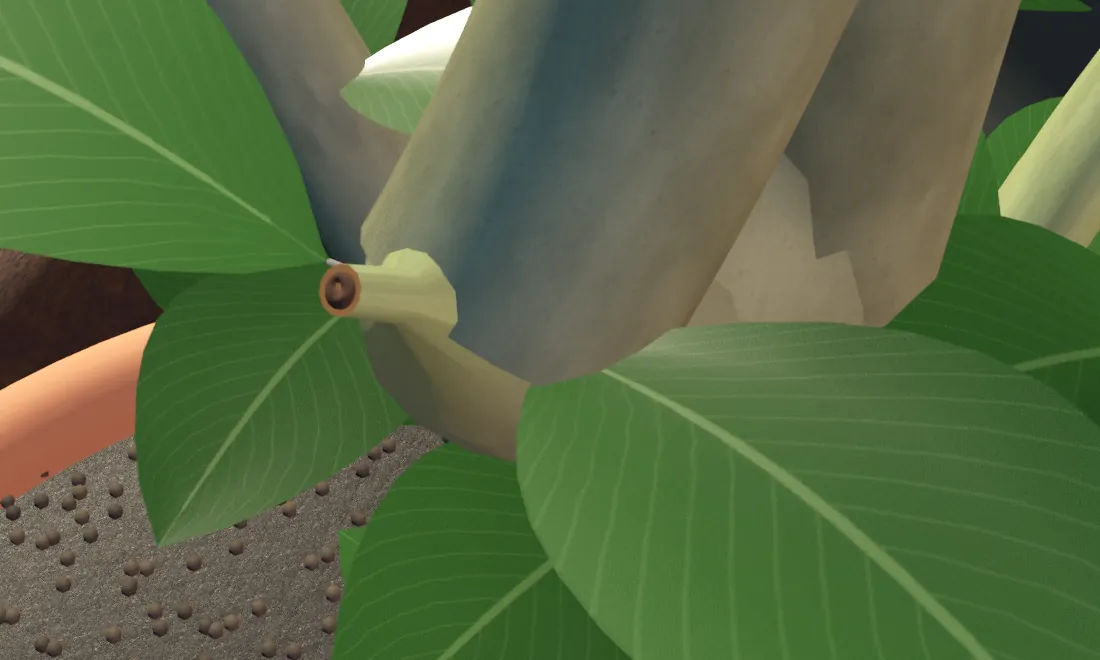
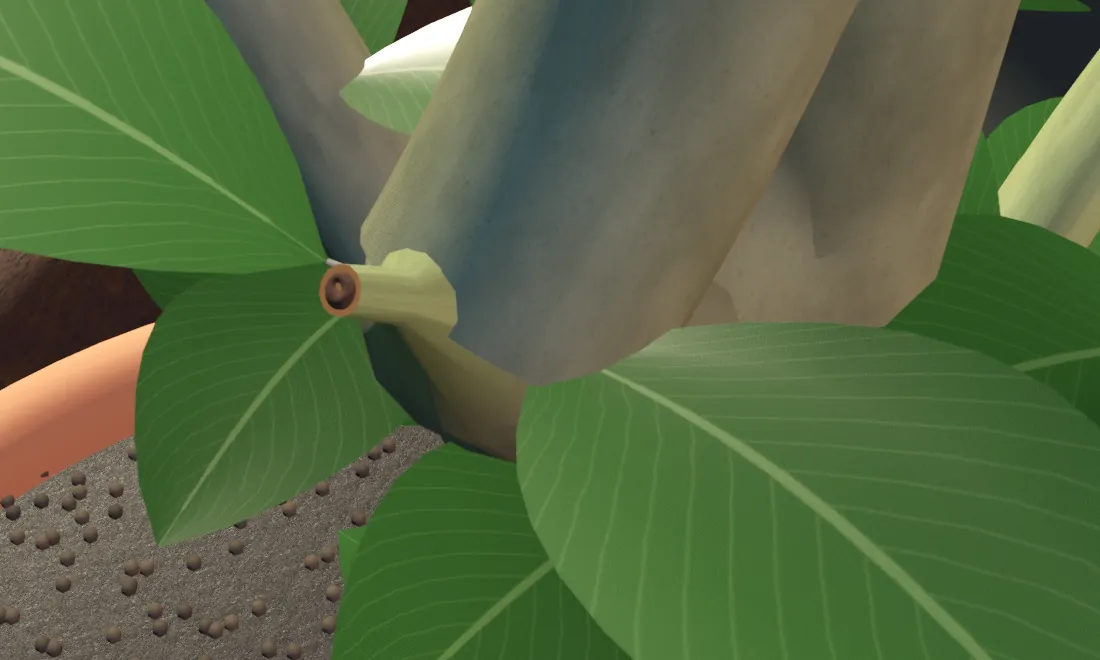
The cutters select the branch they cut, so a fresh cut is always seen selected. The highlight was a warm glow that grew stronger as a surface turned away from the camera. Seen down a stub's length, a branch and its flared base turn away almost everywhere, so the whole junction glowed. The bark change two days earlier was real, but the glow covered it.
An outline instead
The selection is now an outline about five pixels wide where the surface turns edge-on, with a faint lift inside. Within a hand's breadth of the camera, between 14 and 5 cm, the outline fades out, because there the wood fills the view and a branch seen down its length is edge-on all over. At the bench's normal distance a thin twig is outline all over, so a selected sapling stands out as before.
The new check measures how much the selection brightens the stub's base and flare in that close frame. With nothing selected the base measures 0.384 on a scale of 0 to 1, and the outline lifts it by about a quarter of what the glow did. The check fails if the lift climbs back above 0.04, or if the selection stops showing at all.
| The cut branch, selected, seen from just past its end | Brightening over the stub's base (mean luminance, 0 to 1) |
|---|---|
| The old glow | 0.047 |
| The outline, now | 0.011 |
| Where the check fails | above 0.04 |
Every stone its own
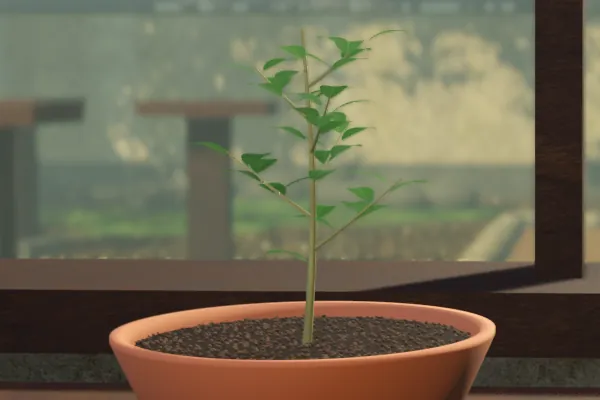
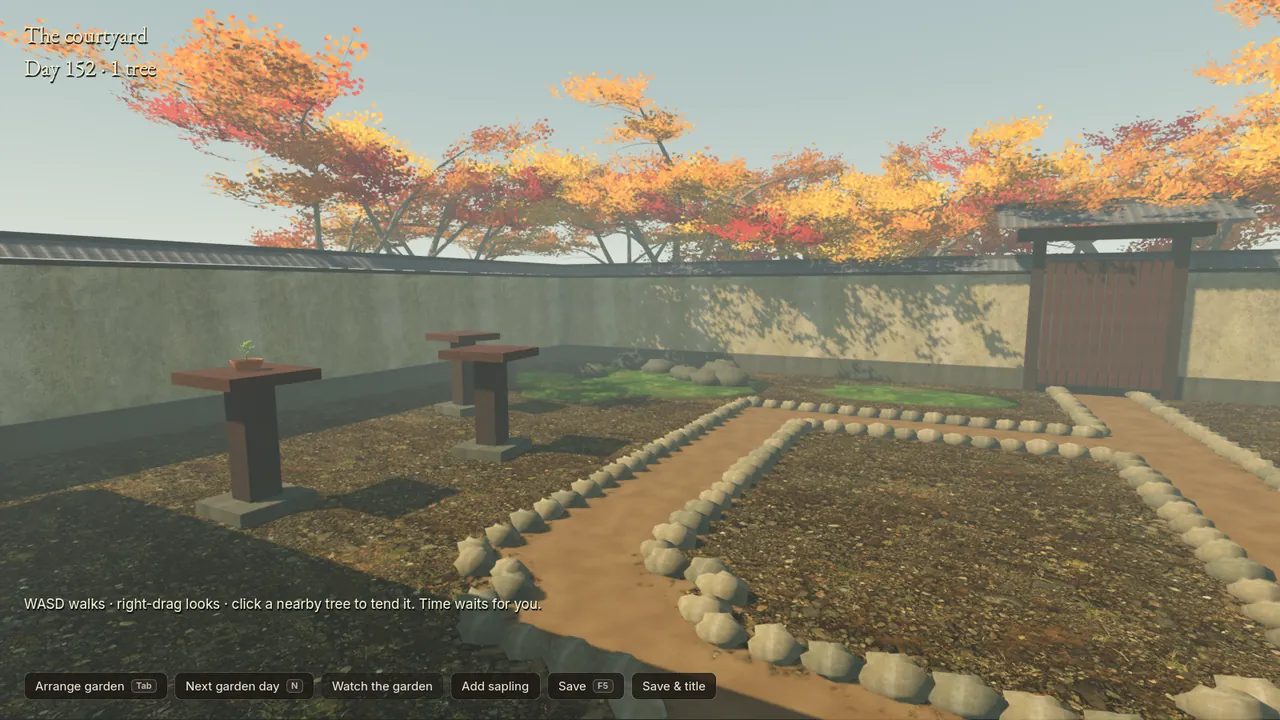
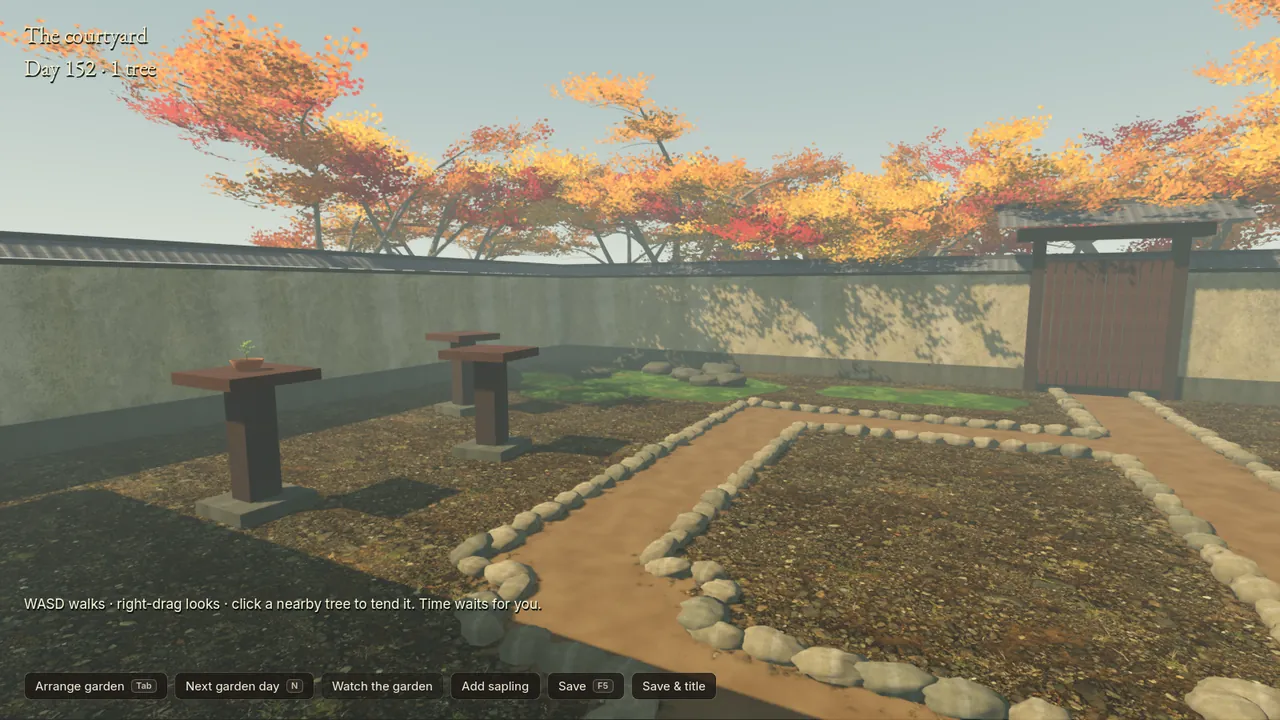
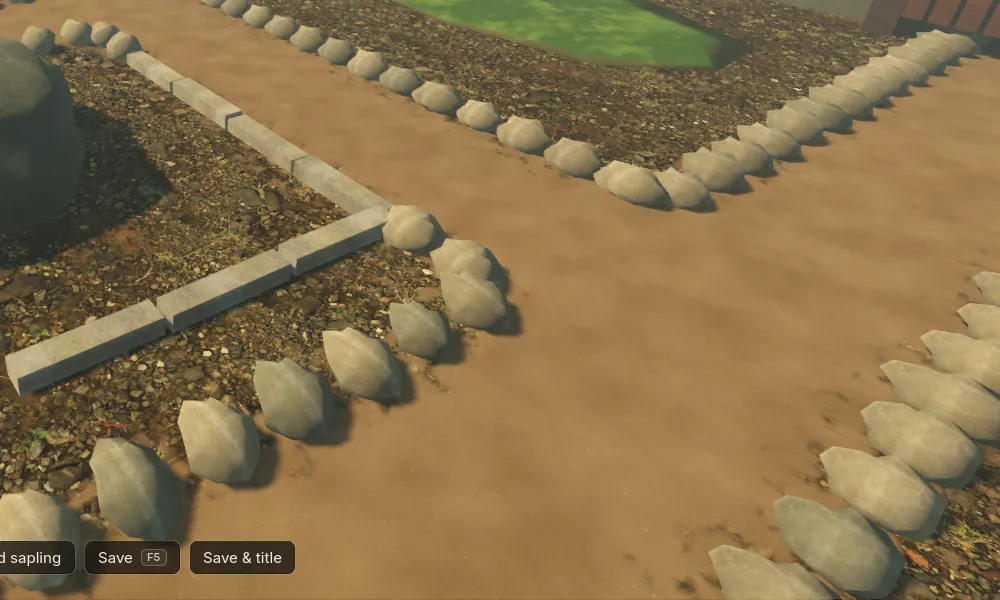
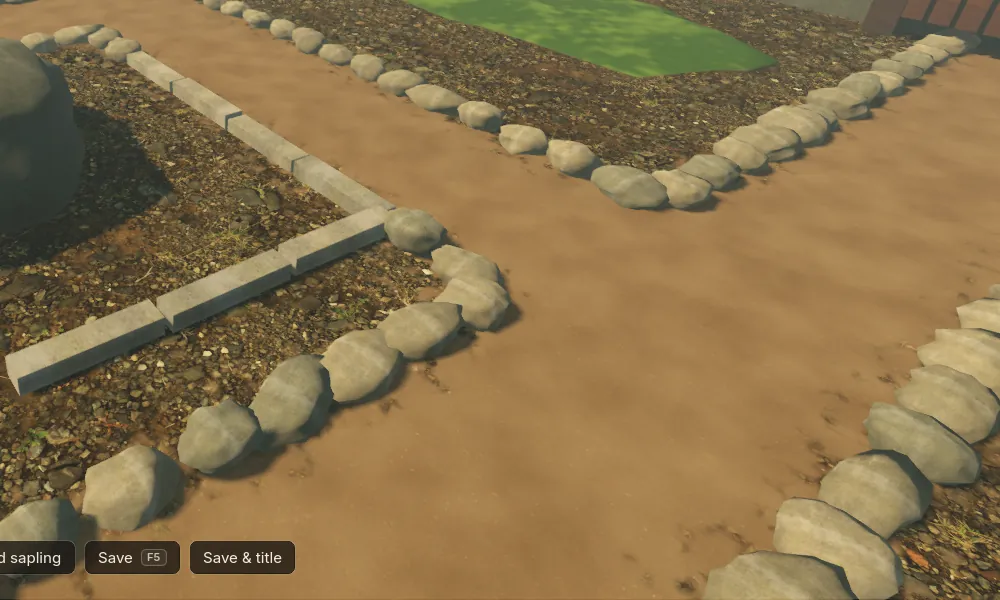
On this look the trees beyond the wall were better ("background trees look way better"), but the stones were not: "the stones need to be varied, not just duplications". They were all one shape. Every stone was a sphere of 9 by 5 facets pushed in and out by one wave, and the path's 200-odd edging stones were one mesh, all facing along the path.
Now each stone has its own shape: lumps from seeded noise at two scales, its own proportions, a flatter face set upwards (garden stones are chosen and set face up), and a slight skew. The path's edging draws from ten shapes, and each stone gets its own turn, tip, setting depth and size, from 19 to 34 cm long. The loose stones by the rear wall and the ring round the future pond keep their places but turn their own ways. The new kerbs stay alike, because they are cut stone.
A mat for the tools
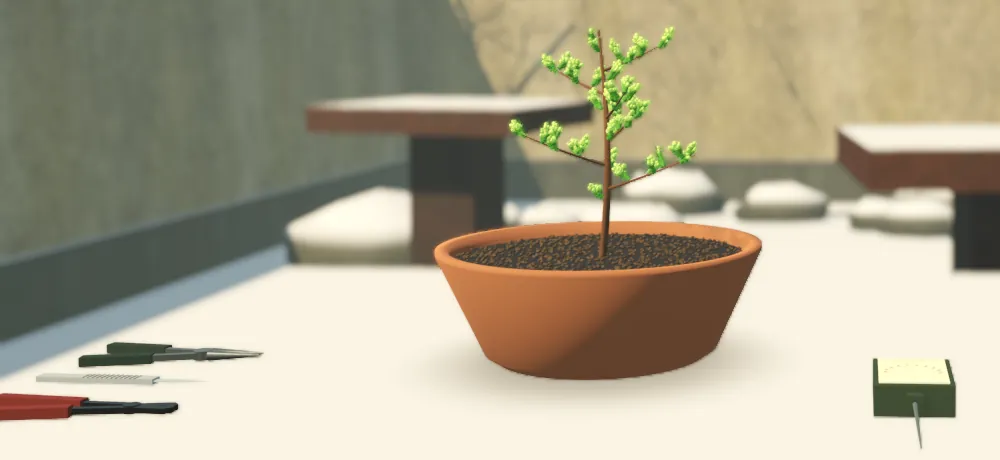
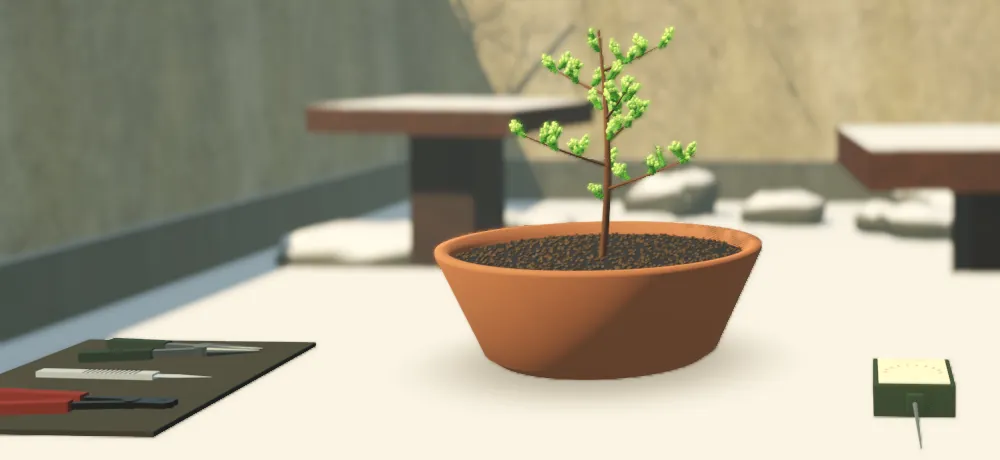
The winter pedestal "looks good otherwise", with one ask: a pad for the tools to rest on when the tree is outside. The pliers, scalpel and cutters lay on the bare pedestal top, and in winter on the snow. They now lie on a felt mat like the one on the grow table, 16 by 20 cm and in the same place beside the bowl, whenever the tree is kept outdoors. The moisture probe still stands beside the bowl.
A still day in the courtyard
The courtyard air failed twice by ear, first sounding like traffic and then like frying. Last time it became smooth wind, with two quieter takes waiting for a listen. The pick was the still day: a near-silent bed of air, a far wind that swells now and then in the trees beyond the wall, and a few distant birds. The game plays exactly the file that was heard. It is about 9 dB quieter than the wind it replaces, with nothing low enough to sound like traffic and nothing spiky enough to sound like frying. The watering keeps the first sound.
| Courtyard air | Centre of the sound | Energy below 200 Hz | High-band spikiness (plain noise is 3) | Loudness (A-weighted) |
|---|---|---|---|---|
| Wind, in the game until now | 1,635 Hz | 0.07 % | 3.0 | -38.4 dBFS |
| Wind with distant birds | 1,970 Hz | 0.06 % | 3.0 | -47.1 dBFS |
| A still day, in the game now | 1,846 Hz | 0.04 % | 2.9 | -47.2 dBFS |
A rock, a water basin and kerbs
While the third round was out for review, the courtyard got three new pieces for its ground plan.
A large rock, set a third into the ground, about 1.3 m across and leaning a little. It is built finer than the small stones, since facets would show at its size. A water basin, a tsukubai: a hewn granite basin holding still water, a flat front stone, a taller and a lower stone either side, a bed of dark pebbles and a bamboo spout behind. The water is still, because the game draws no flowing water it does not simulate, and in winter the basin freezes under the snow. And kerbs: runs of dressed kerbstones laid by dragging along the grid's lines, one stone to each half metre and up to 8 m. A kerb is low enough to step over, so it may cross a path. Along a path's edge it takes the place of the path's loose stones, and an undo brings them back.
- Like any solid piece, the rock and the basin may not cut a tree or the veranda off from the gate: a row of large rocks across the garden is refused.
- Every placed piece can now be removed, and every removal undone. Stepping stones and lanterns could not be removed before.
- The tray of pieces wraps onto a second line at 1600 px wide, and it covered the actions row when it did. The new check caught it, and the rows are now laid out again when one changes size.
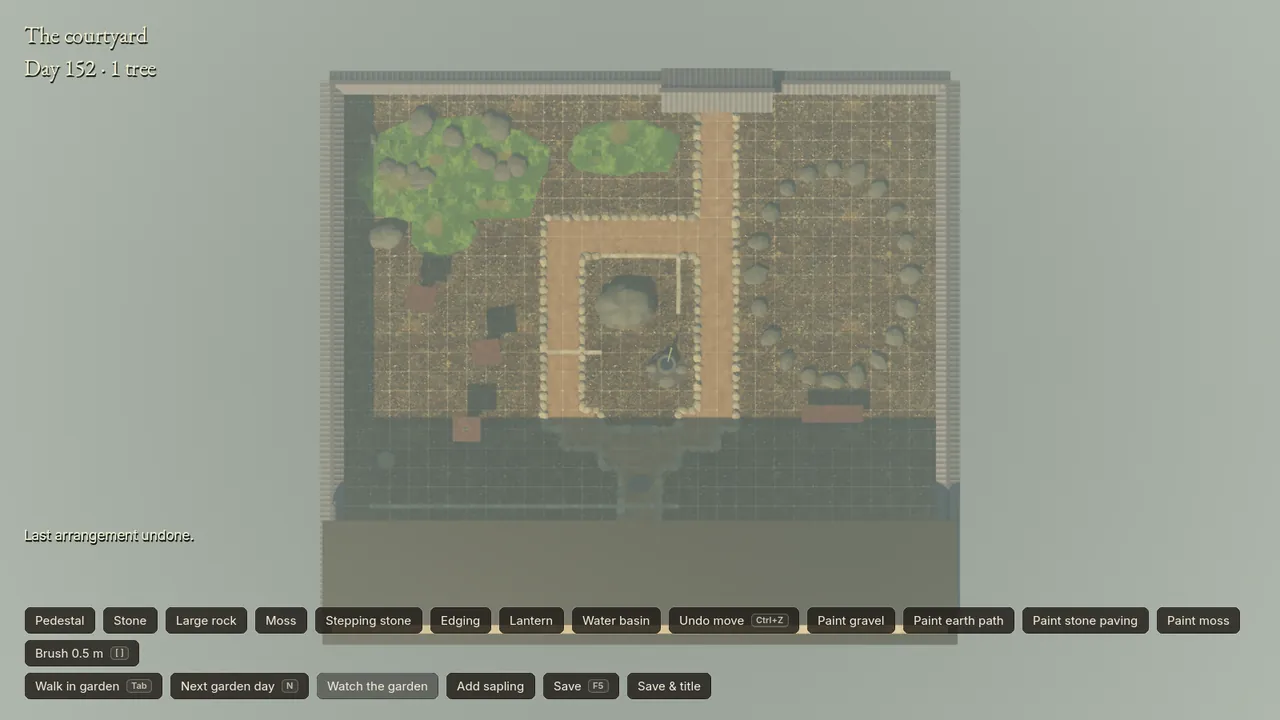
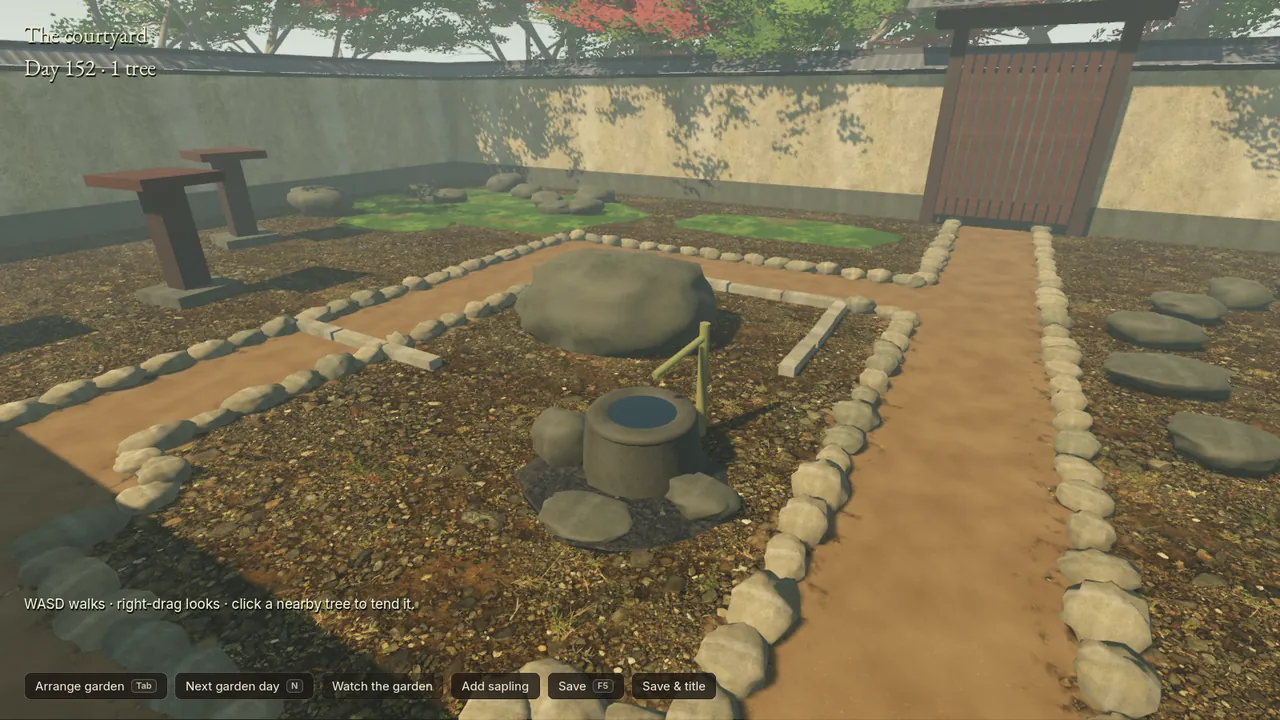
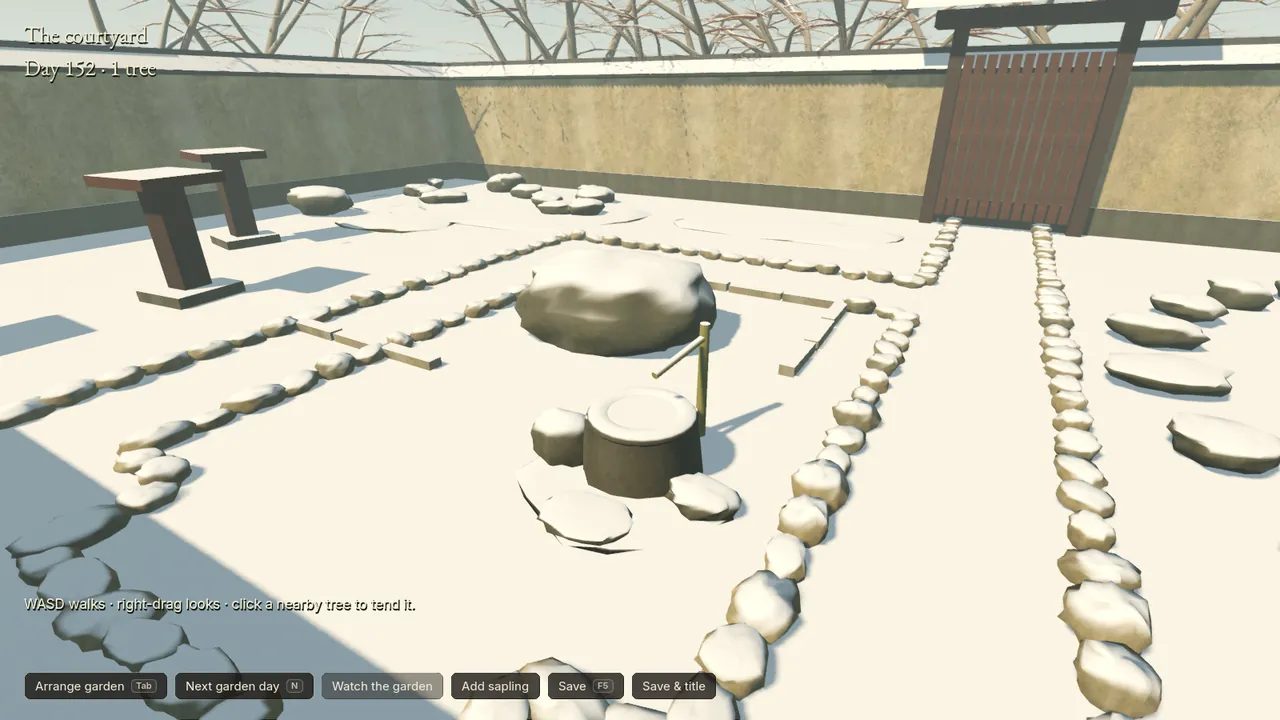
The check places each piece through the game's own input. It refuses a rock on the path and lays one beside it. A 2 m drag lays four kerbstones in place of eight loose stones, and one undo brings the loose stones back. A 10 m drag stops at 8 m. Every piece goes through a save and a load.
What's next
- Decide whether the water basin plays a quiet trickle when you stand near it, or stays silent.
- Look again at the cut with the new outline, the stones, the tool mat and the new pieces.
- Then a path rule for the pond once it holds water, more pieces, and the front of the house and its veranda.
What I learned
Before changing what something looks like, find out which layer draws the colour you see. Turning each layer off in turn, first the collar and then the selection, found it after two rounds spent on the wood. A highlight that grows with the viewing angle is fine on a thin twig and floods a thick surface seen edge-on. And a picture that looks unchanged after a fix is a finding: the fix is not where the eye is.
Sources & development context
Based on House of Bonsai's source history and notes from 13 and 14 October: the check runner's records (runs 20261013-163428 to 20261014-104419), the study captures (windowed runs on the development PC at 1600 by 900, the cut and the selection at 1920 by 1061; several pictures are crops), the wound-collar check's brightness measurements, and the synthesis report for the courtyard air. These are game captures and model outputs, not field measurements.