
The tree goes outside
The review ended with nineteen answers, and the first one I built changes where you tend. A tree kept outdoors is now tended on its own pedestal in the courtyard, with the courtyard around it; a tree kept in the growing room stays on the grow table. Moving a tree in or out changes the scene in the same frame you press the key, without rebuilding the tree.
The courtyard got a winter too: snow from early December to late February on everything that faces up, patchy where it is thin and never under the veranda roof.
| January views | Pixels past white, first round | Second round |
|---|---|---|
| The courtyard from the gate | 21 % | 0 % |
| A juniper on its pedestal | 20 % | 0 % |
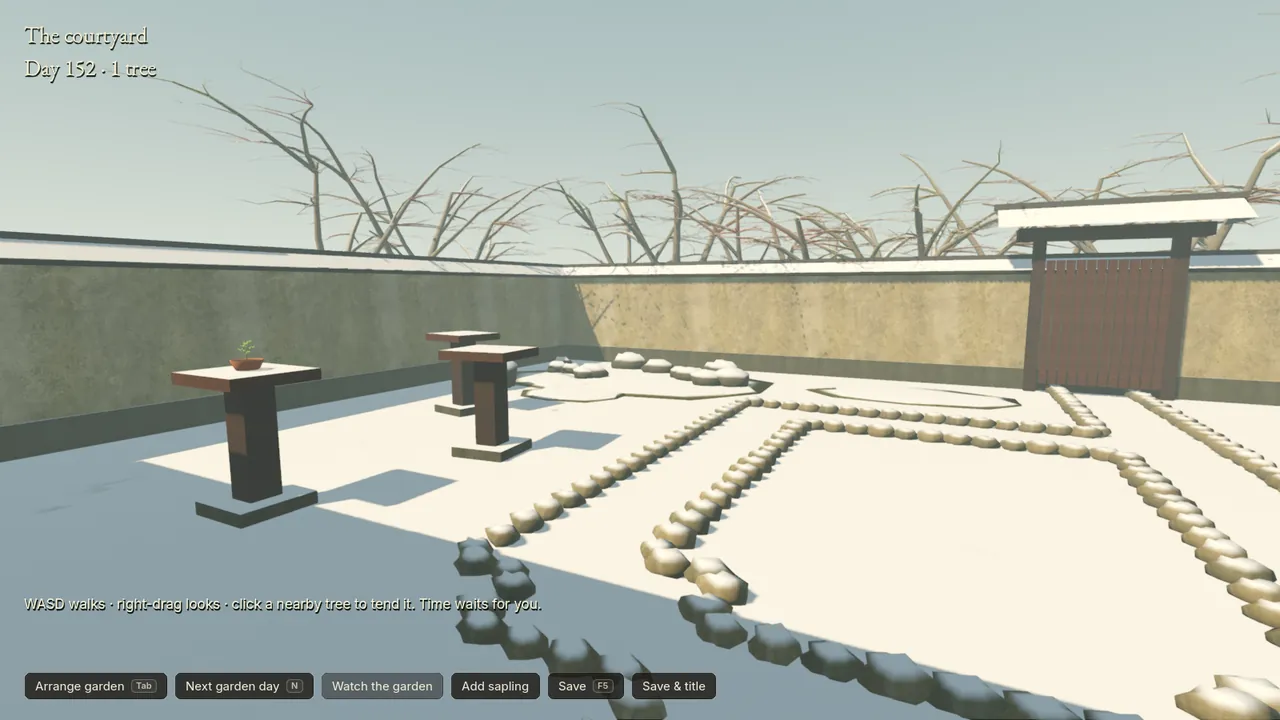
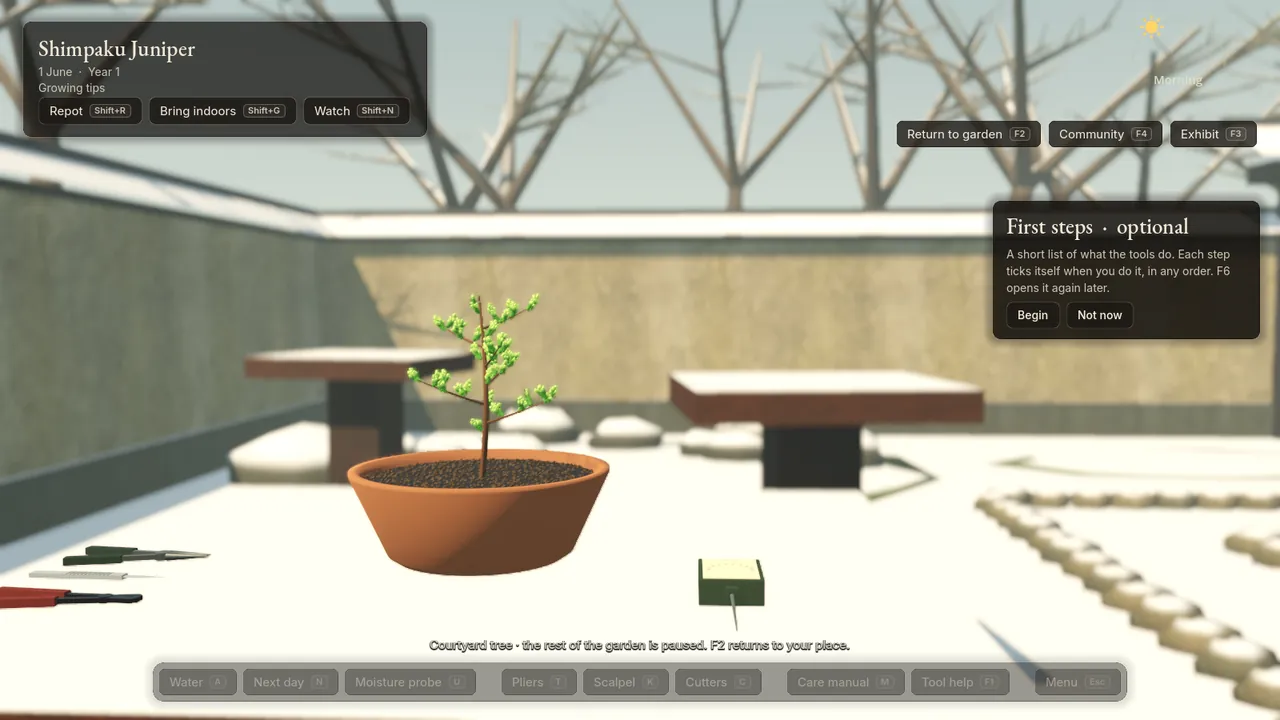
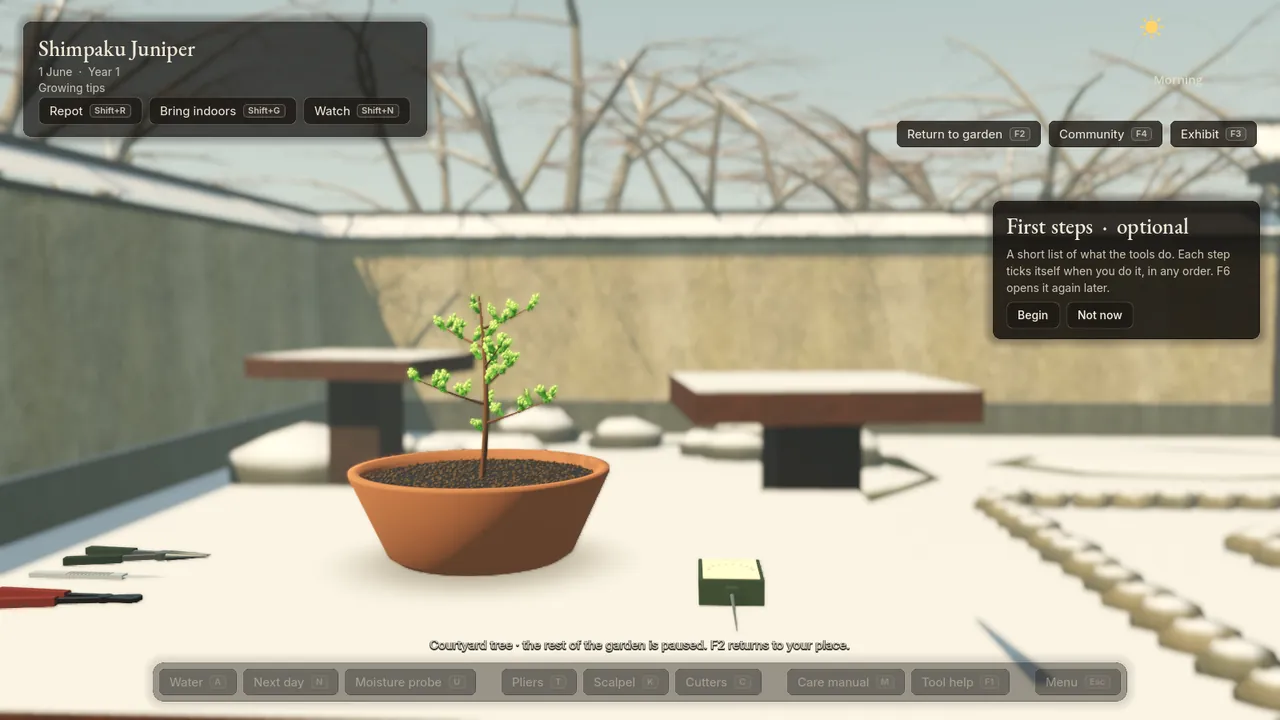
On the second look the note was that the bowl seemed to float on its pedestal. A shadow was asked for, but it was only half the answer: the snow was so bright under the courtyard sun that a fifth of the picture went past white, and nothing can show on a surface past white. Snow that has lain for weeks reflects about half the light, and at that nothing clips.
The pedestal outdoors is part of a picture of the courtyard drawn behind the tree, which the tree's own shading never reaches. So the bowl now casts a contact shadow of its own, darkest under the foot and fading out past the rim, in every season.
A temple garden
The courtyard's plain walls became temple walls: warm plaster on a stone plinth under small gabled roofs of grey tiles, and the gate under a roof of its own. Seventeen Japanese maples stand beyond the walls. They leaf out from late March, turn from yellow-orange to crimson from mid October, drop their leaves into early December and stand bare in winter.
On the second look the basics worked, but the trees and ground cover needed to look real. The first maples were straight sticks carrying solid balls. Now each tree has several stems, with curved limbs that rise and arch. Its leaves are small sprays: cards showing sprigs of seven-lobed maple leaves in opposite pairs, drawn by a tool from the leaf's described shape and set in level layers with sky between them. Leaves come and go one at a time, the top of a crown colours first, each leaf takes its own shade between yellow and crimson, and three trees are red-leaved, as temple gardens often plant them.
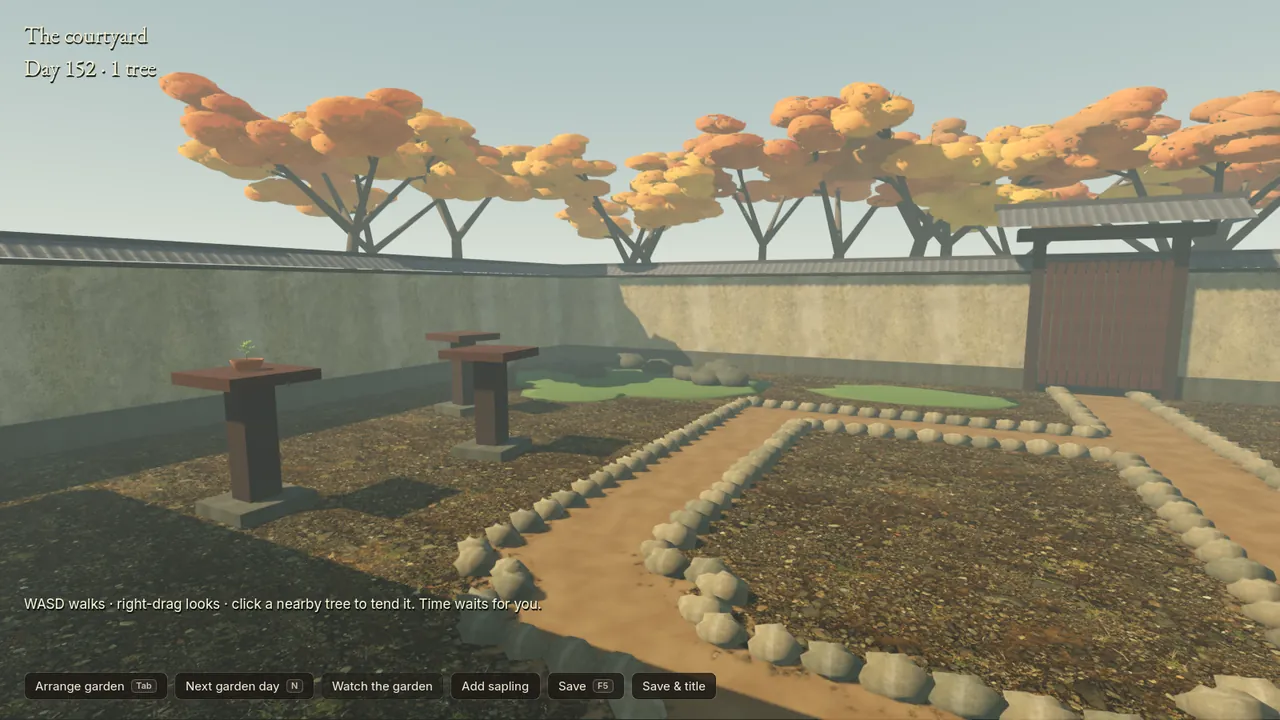
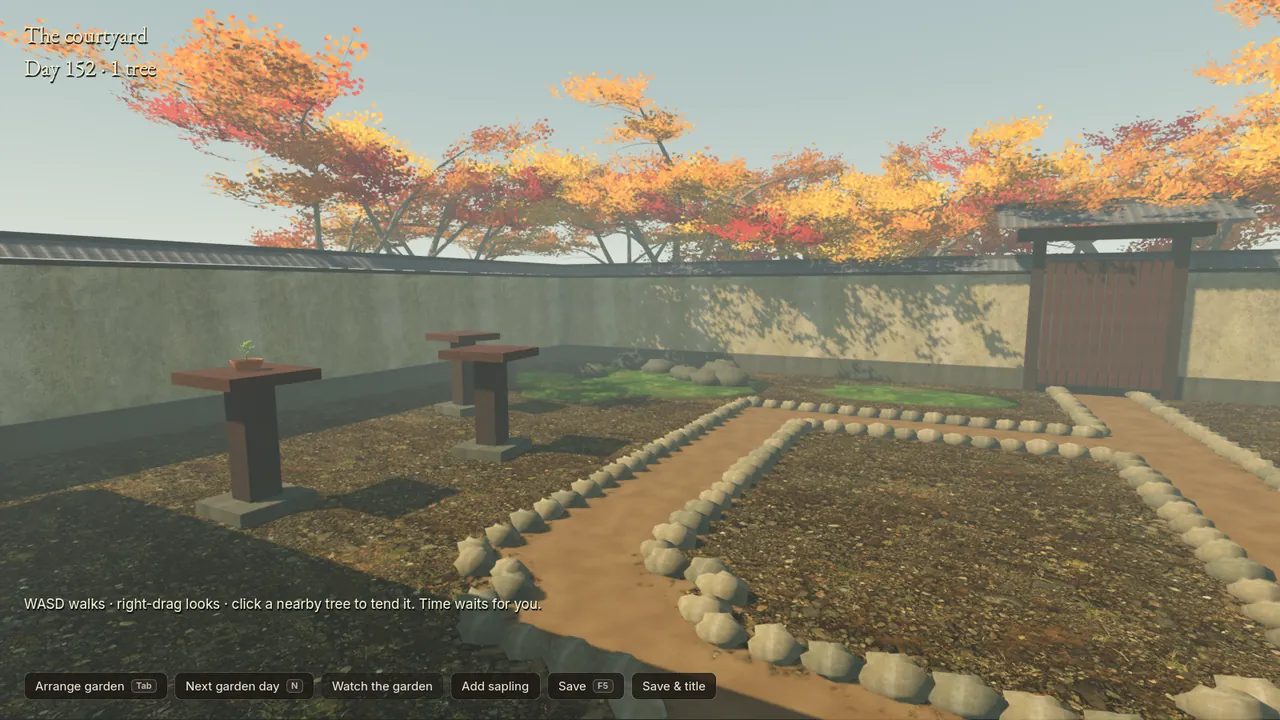
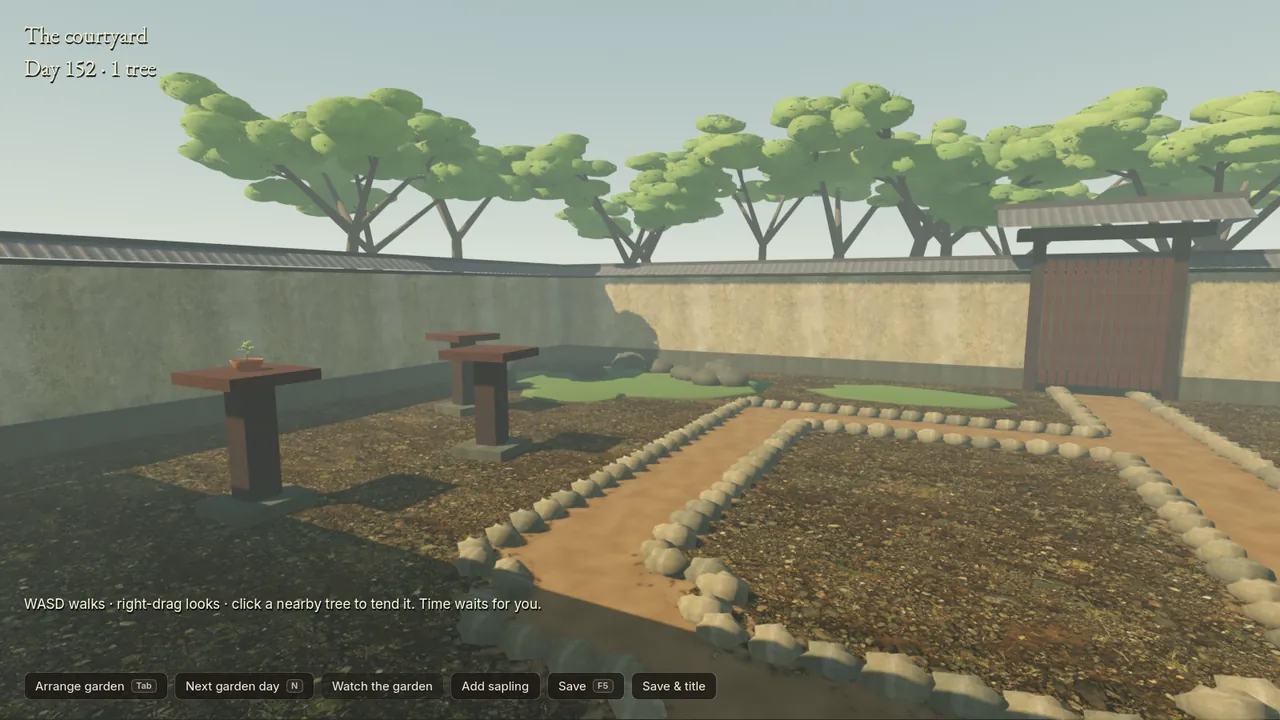
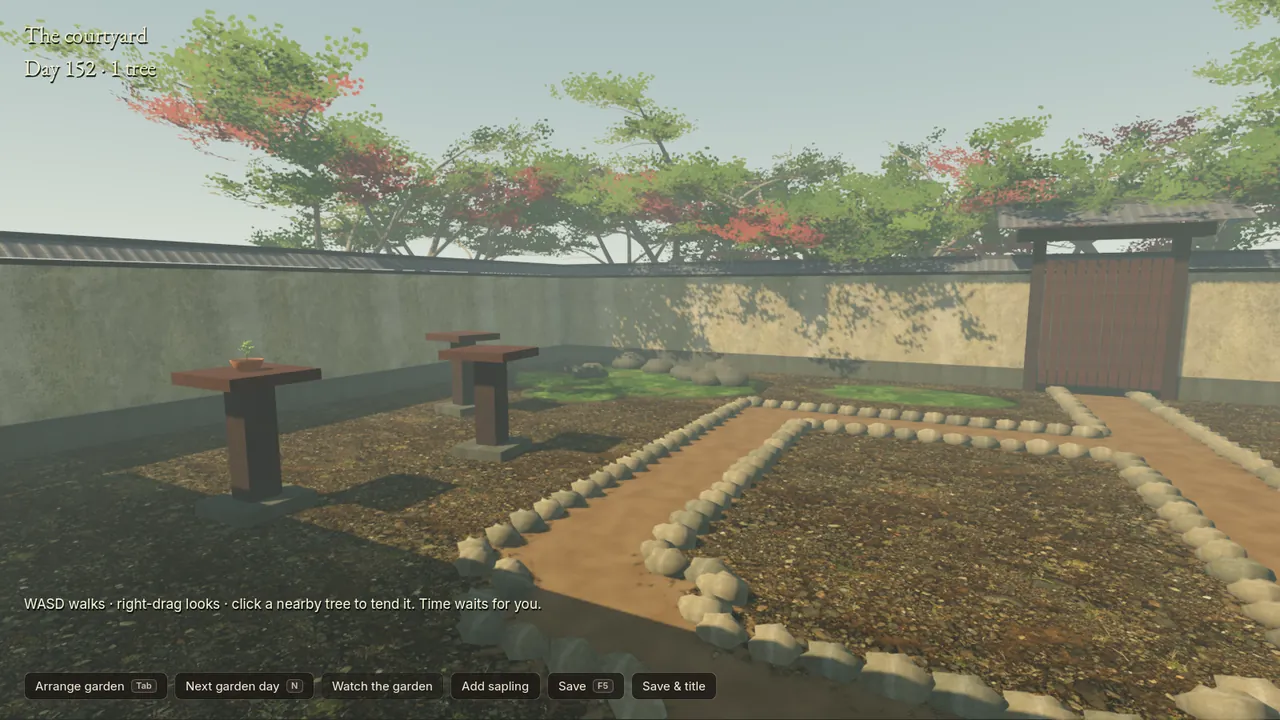
On the development PC the courtyard with three dense trees costs what it did before the rebuild: 3.35 ms a frame, against 3.37.
Ground you can paint
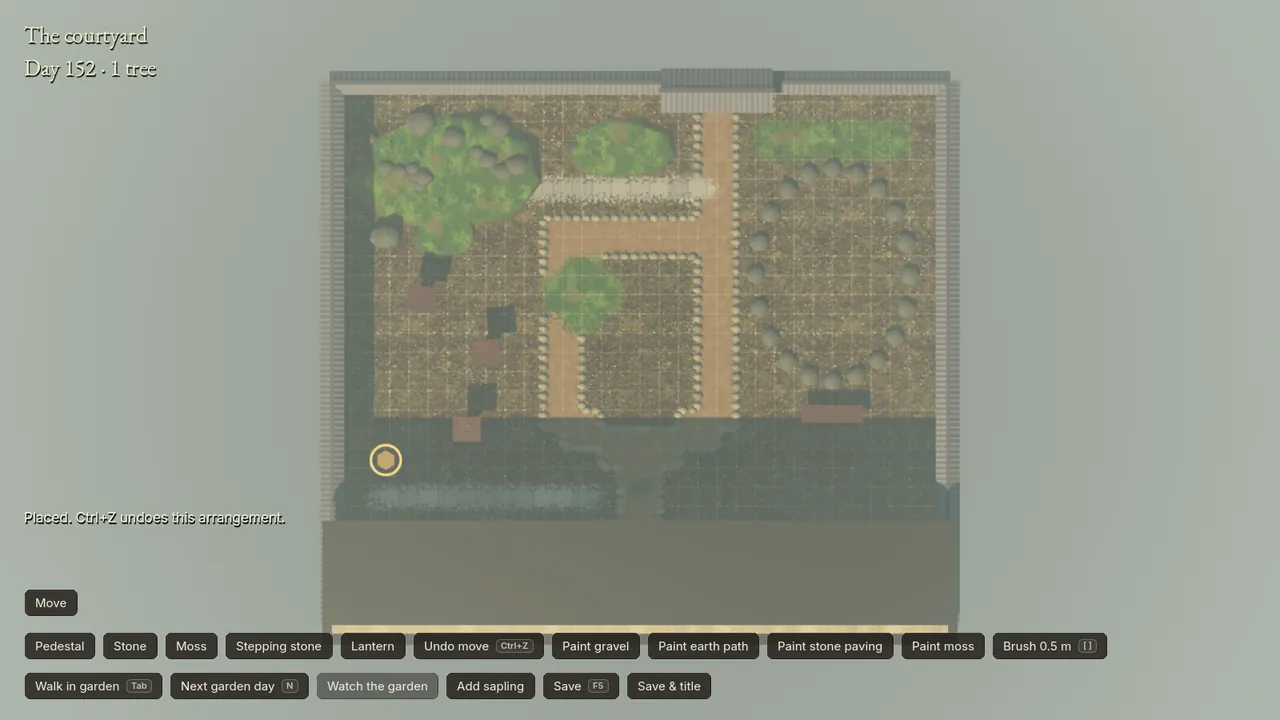
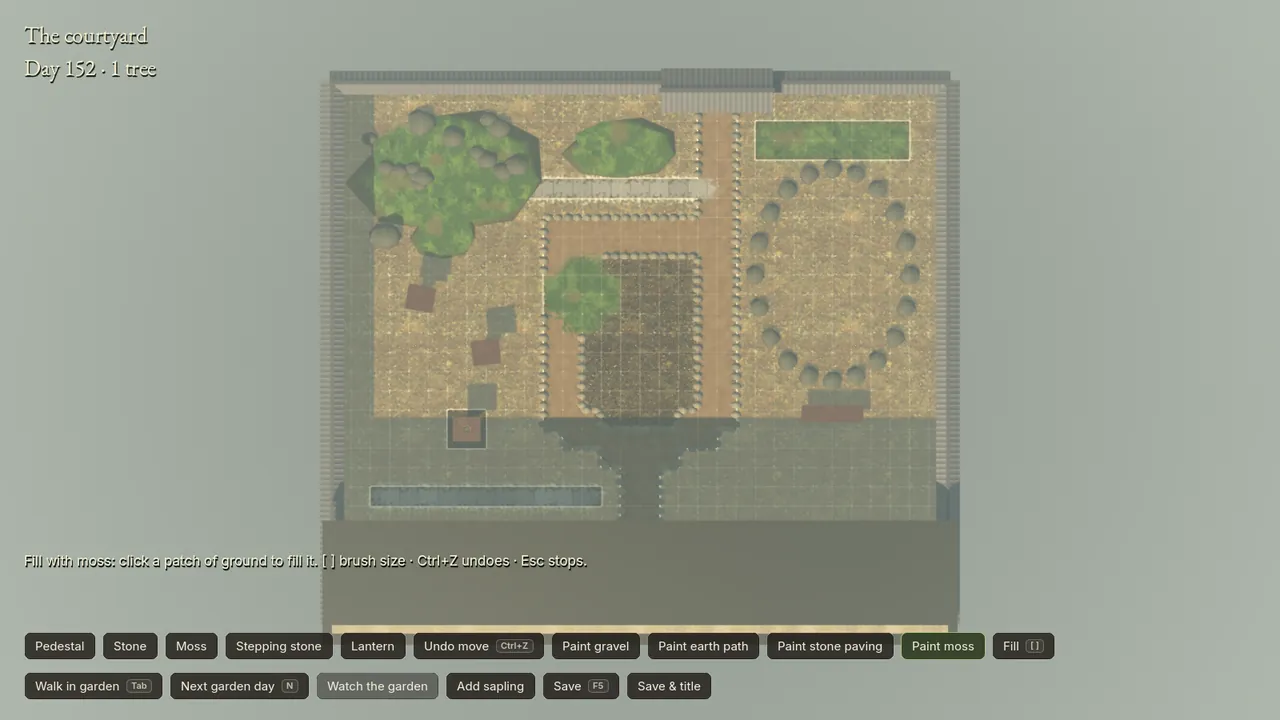
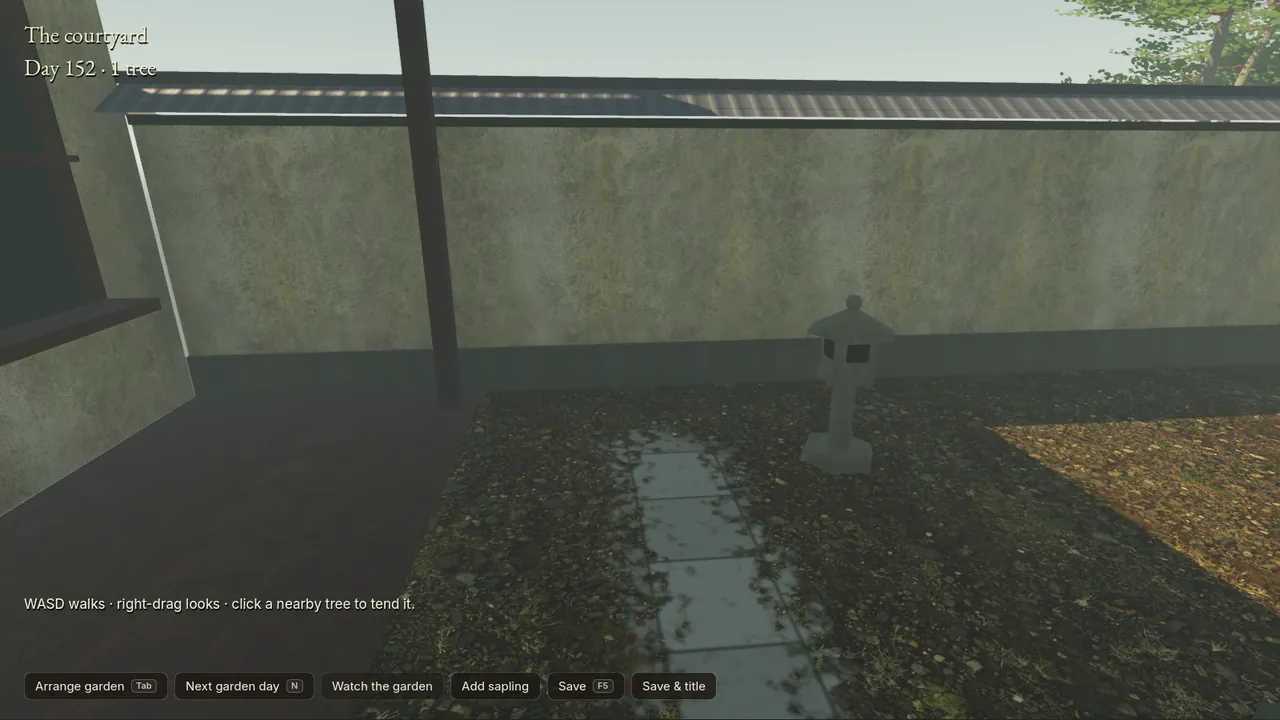
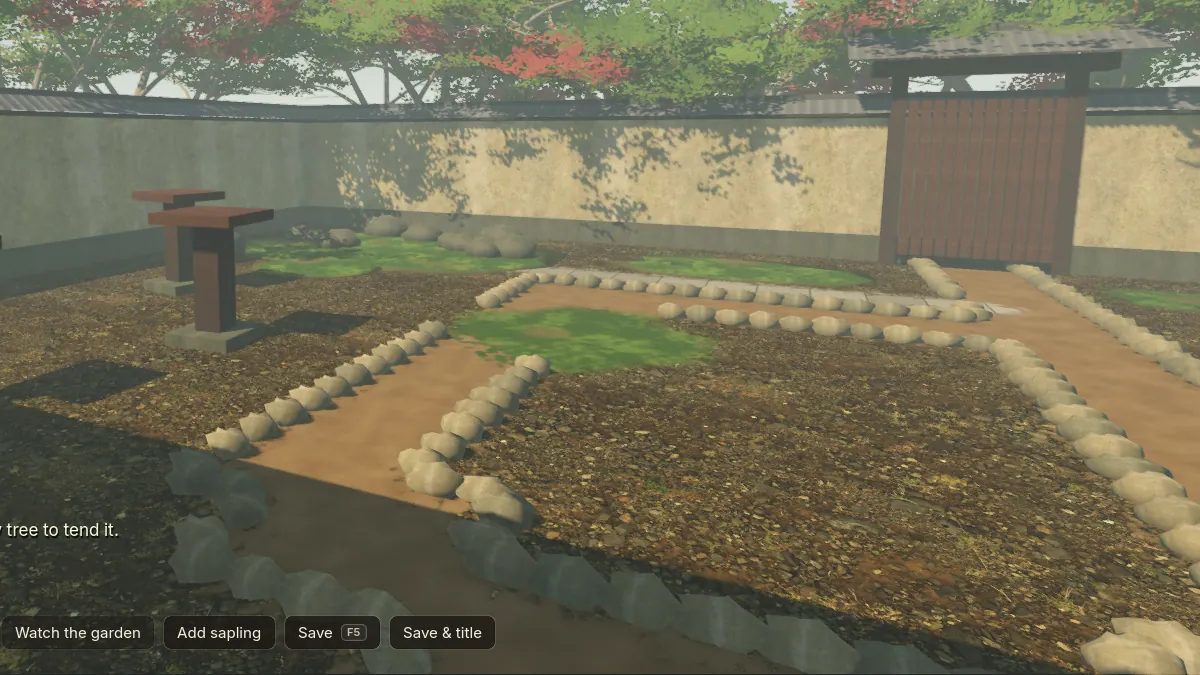
The courtyard's layout used to be fixed. Now its ground is a plan of half-metre cells that you paint from above: gravel, earth path, stone paving and moss, with brushes from half a metre to two metres and a fill. Stones edge a path wherever it meets gravel. Pieces go on top: stepping stones, which are the only piece allowed on a path, and stone lanterns, alongside the pedestals, rocks and moss beds. No piece may close the way from the gate to any tree or to the veranda. The game walks the grid as you place and refuses any piece that would cut a tree off.
The moss used to be one flat green. Now it grows in low cushions, deep green in the hollows and yellow-green on top, with a velvet up close and the odd dry patch, and the earth path shows its grit.
Roots, above and below the soil
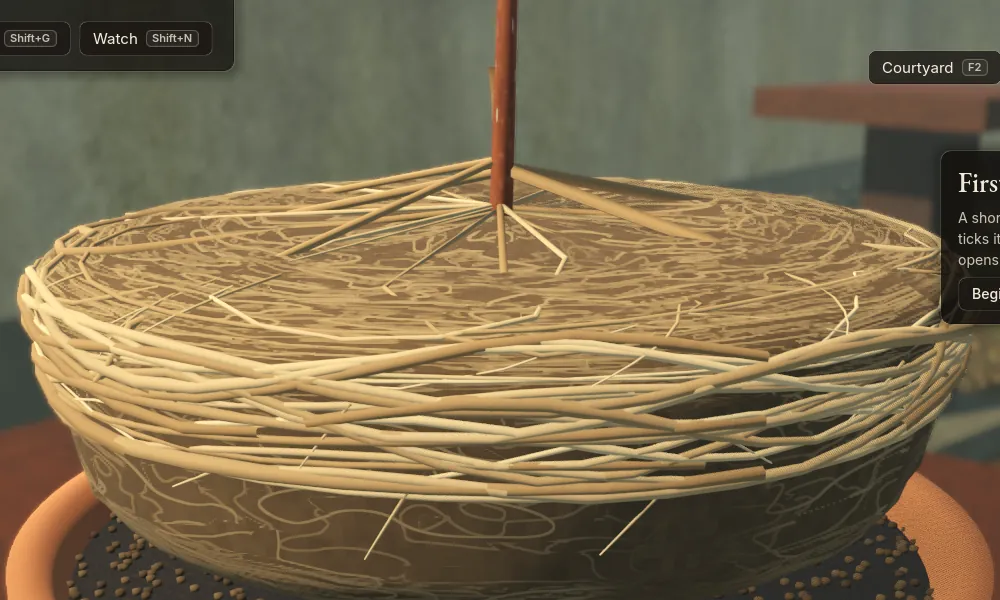
Lifted from its pot, the root ball now takes the pot's shape as the roots fill it. A young tree's is a crumbly lump; a pot-bound one has the bowl's oval and flat foot. Woody roots spread from the trunk, circling roots wander as they go round, fine side roots leave them, and a pot-bound ball is matted underneath.
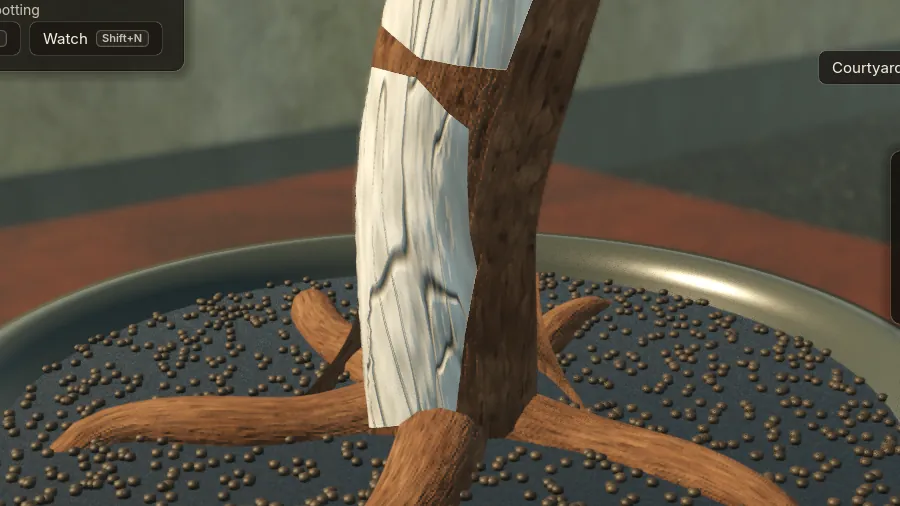
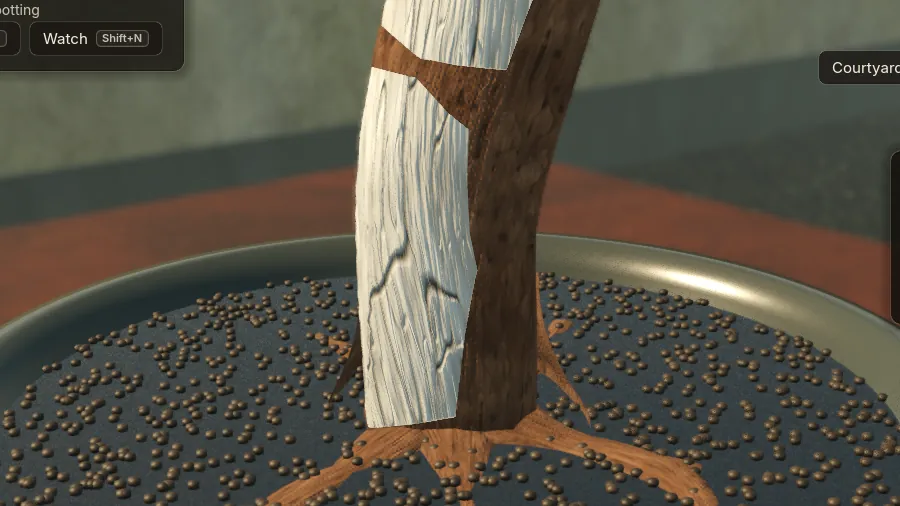
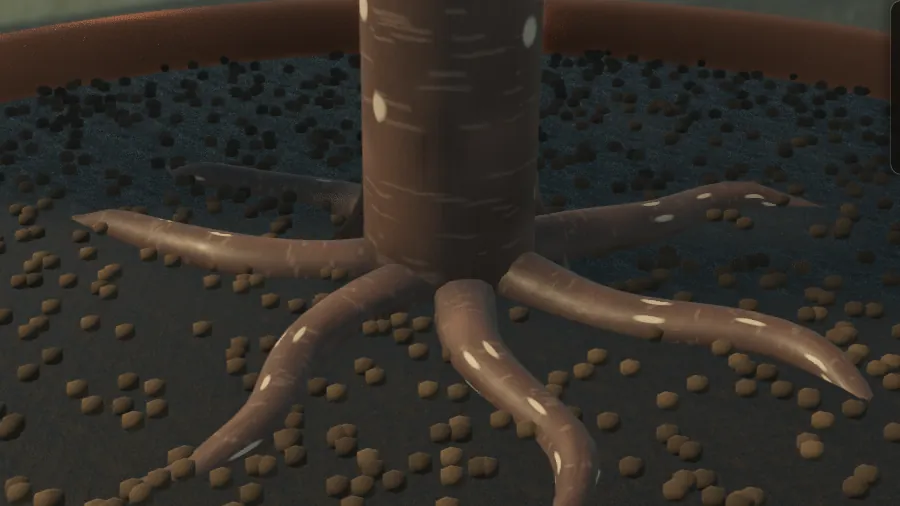
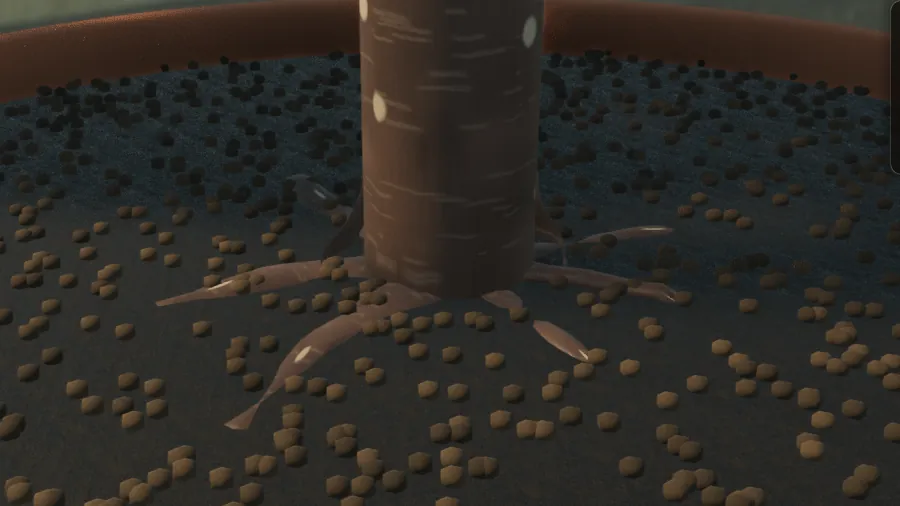
Above the soil, grown trees had no flare at all. Now the trunk widens into the soil and surface roots radiate from it, growing from the trunk's own thickening. On the second look they read as 'a tentacled animal', and fairly so: equal round tubes at equal angles, all one length, tapering alike to points on the grit. Now the gaps between them vary and one root leads. Each runs its own length, kinks, swells and sometimes forks. It rises from the flare as a ridge, dips under and shows again, and goes into the soil while still thick.
The juniper's white deadwood looked blurred, and it was. Its fibres were counted per turn of the stem, so on a thick trunk each one was three millimetres wide. Now they keep a real size, with fine grooves between them.
A stub that dies
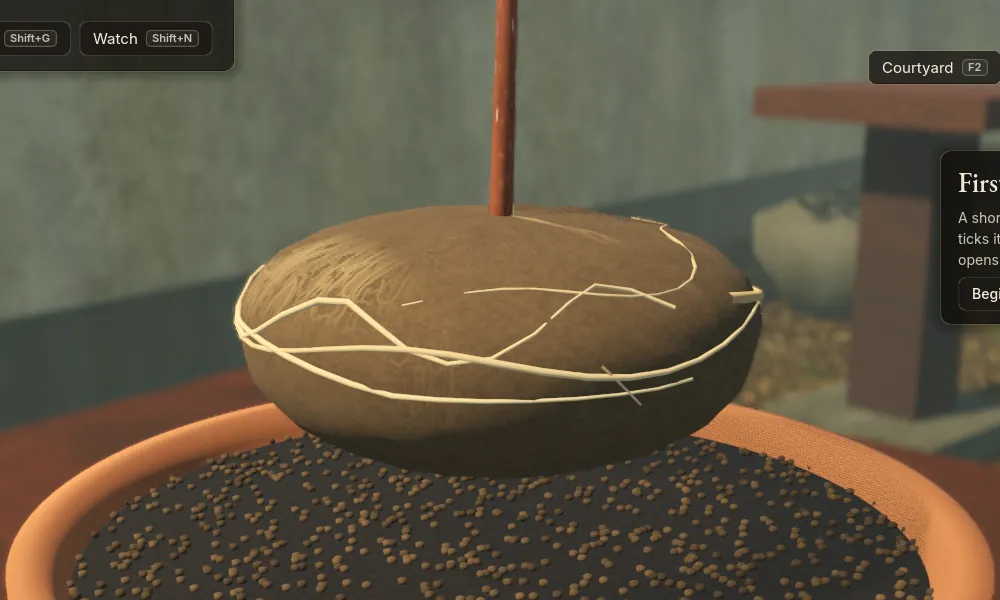
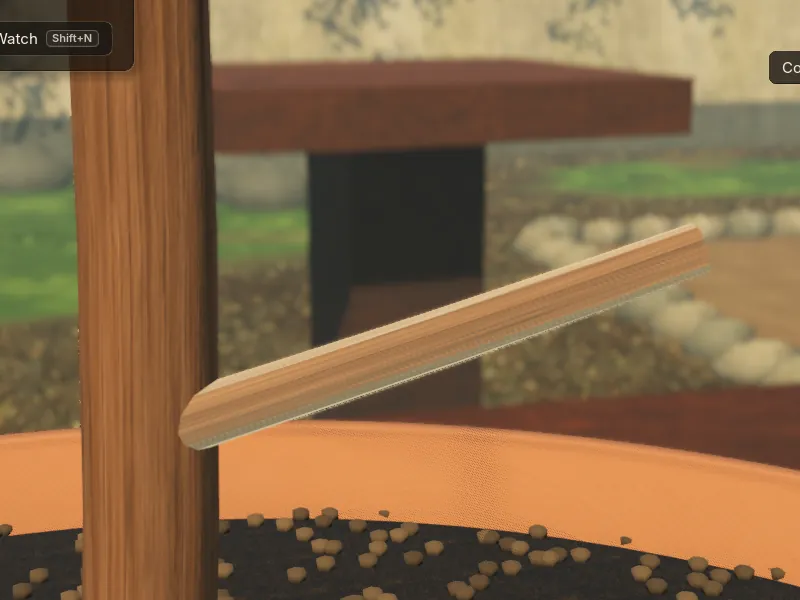
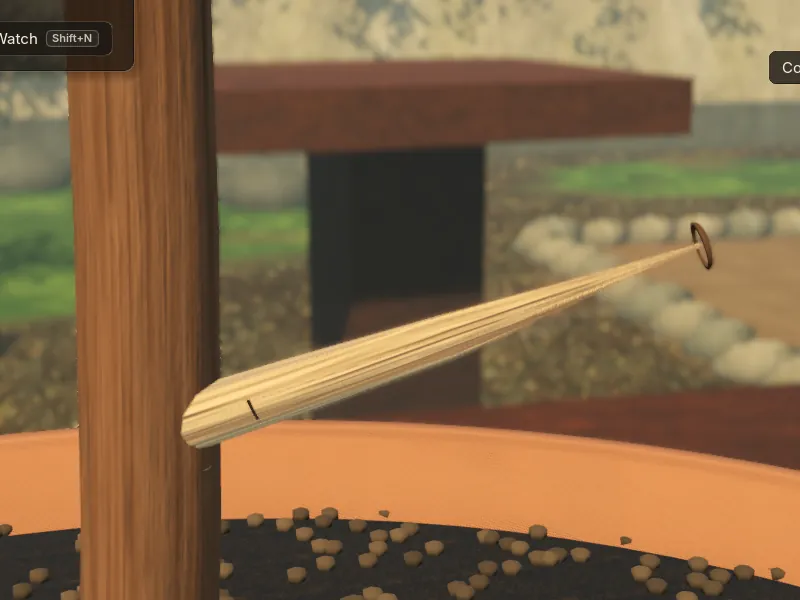
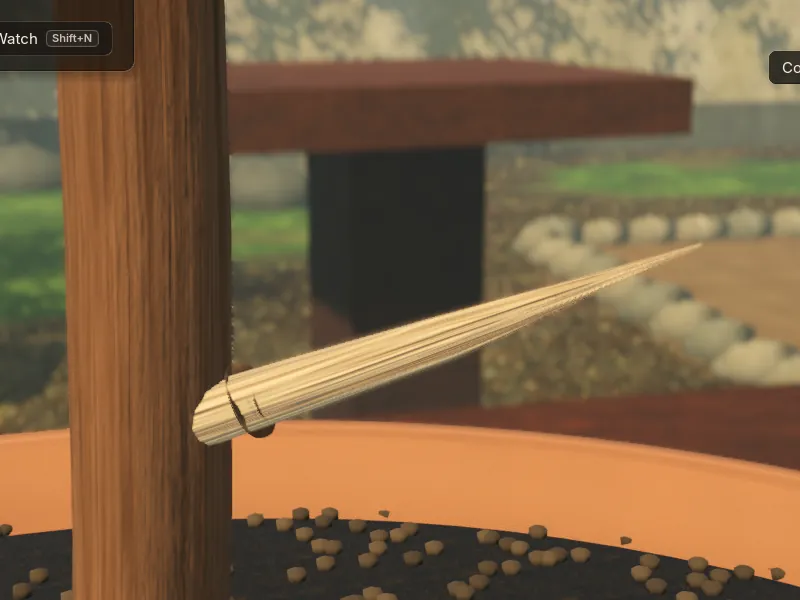
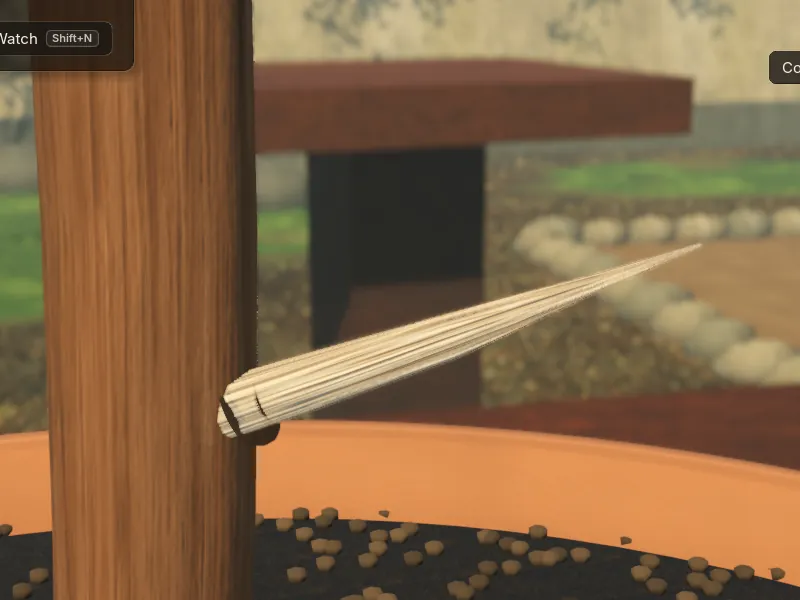
One note said a cut stub looked as if it were being sucked into the trunk. When I measured that frame, it had been taken at fifty times growth, and the stub was alive: it had kept three leaves, its buds had broken and it had thickened beside the trunk. The smooth blend between the two took the branch's pale bark. Now the blend keeps the trunk's bark until close to the branch, as a branch collar does. And a bare stub, with no leaves and no shoots, dies back over the weeks after the cut: it greys, loses the blend, and the trunk's new wood rolls round its base.
The courtyard air, by ear
Two sounds failed by ear twice. The first courtyard air was 'like car traffic': a band of low noise over a rumble. Its replacement, many small leaf rustles, was 'like sizzling grease': about eleven sharp grains a second in the high band, which is what frying sounds like. The air is now smooth wind: three bands that swell and brighten in slow gusts, with nothing low enough to sound like traffic and nothing spiky enough to sound like grease. The checks that guard the loop now reject both.
| Courtyard air | Centre of the sound | Energy below 200 Hz | High-band spikiness (plain noise is 3) | Sharp grains a second |
|---|---|---|---|---|
| First: 'like car traffic' | 841 Hz | 3.4 % | 2.9 | 0 |
| Second: 'like sizzling grease' | 2,613 Hz | 0.003 % | 6.5 | 11 |
| Now: wind in gusts | 1,635 Hz | 0.07 % | 3.0 | 0 |
Watering, back to the first
The watering went the other way. The first sound was 'a stream of bubbles, should be a gentle stream'. The pour that replaced it was worse to the ear, and the numbers say why: a seventh of its energy was hiss above 3 kHz. The first sound is back in the game, and two gentler takes on it are waiting for a listen.
| Watering | Centre of the sound | Energy above 3 kHz | Sharp onsets a second |
|---|---|---|---|
| The first (in the game again) | 931 Hz | 0.27 % | 6.2 |
| The pour, turned down | 1,913 Hz | 15.2 % | 0 |
| Soft: the first, rounder | 801 Hz | 0.05 % | 0 |
| Trickle: a quiet low stream | 795 Hz | 0.05 % | 0 |
Groundwork for Early Access
The rest of the answers were groundwork.
- Saves now live in a folder named after the game. On the first start the game copies the saves from the old study-named folder once and never touches them again.
- Every package carries Benchmark.cmd. Double-click it on a borrowed PC and it times the bench and the courtyard with no frame cap, then leaves the results on the Desktop. Here it measured 292 frames a second at the bench and 1.2 GB of video memory.
- Release builds leave the developer pages out.
- dev.43 was built and verified after the first round, and dev.44 after the second.
What's next
- Pick the courtyard air (the wind, the wind with distant birds, or a still day) and the watering (the first sound or one of its two gentler takes).
- Look again at the root flare, the winter pedestal and the temple garden, and settle the wounds and the ground painting, which have no verdict yet.
- Hand dev.44 to the first players from outside development.
What I learned
Measure clipping before adding shade. A surface already past white cannot show a shadow, a patch or a contour, so the asked-for shadow was only half the fix. And regularity is a defect of its own: correct roots set at even angles, all one length and tapering alike, read as an animal. Each of the three notes was an impression, and each was measurable.
Sources & development context
Based on House of Bonsai's source history and notes from 12 October: the check runner's records (runs 20261012-152801 to 20261012-233210), the study captures (windowed runs at 1600 by 900 on the development PC), the synthesis reports for the courtyard air and the watering, the build manifests and standalone verifications of dev.43 and dev.44, and the project's growth research log, section 14, for the root flare. The maple leaves are drawn by a tool from Acer palmatum's described leaf shape, not from photographs. These are game captures and model outputs, not field measurements.