
A leaf waits to be replaced
The last log ended on a finding: the refine routine, which strips its ficus every June, went bare by its third spring. The leaves that grew back after the strip all shared a birthday, so 240 days later they all fell together, in February.
I asked three research agents for 61 sources first. In evergreens the old leaves go as new ones come, by their place in the crown rather than their age, and no grower describes a stripped ficus going bare the next spring. One describes an unstripped pot fig as one that 'will cycle old, inefficient leaves off and replace them one at a time'. So now a leaf older than its life (240 days for a ficus) falls only as the tree grows a new leaf, one for one, oldest first across the crown. At twice its life it falls whatever happens.
| The refine ficus's leaves | 13 Dec | 11 Feb | 2 Apr | 1 Jun |
|---|---|---|---|---|
| Leaves fall at 240 days | 107 | 107 | 52 | 43 |
| Leaves wait to be replaced | 112 | 115 | 115 | 107 |
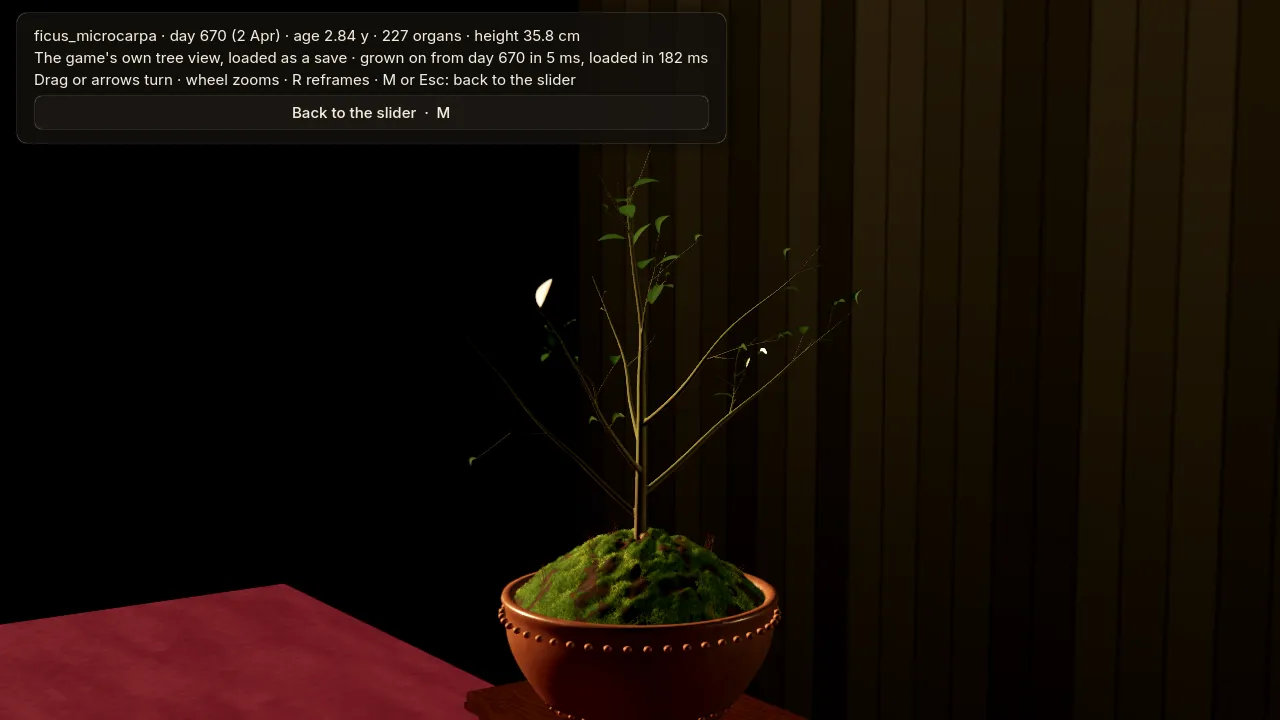
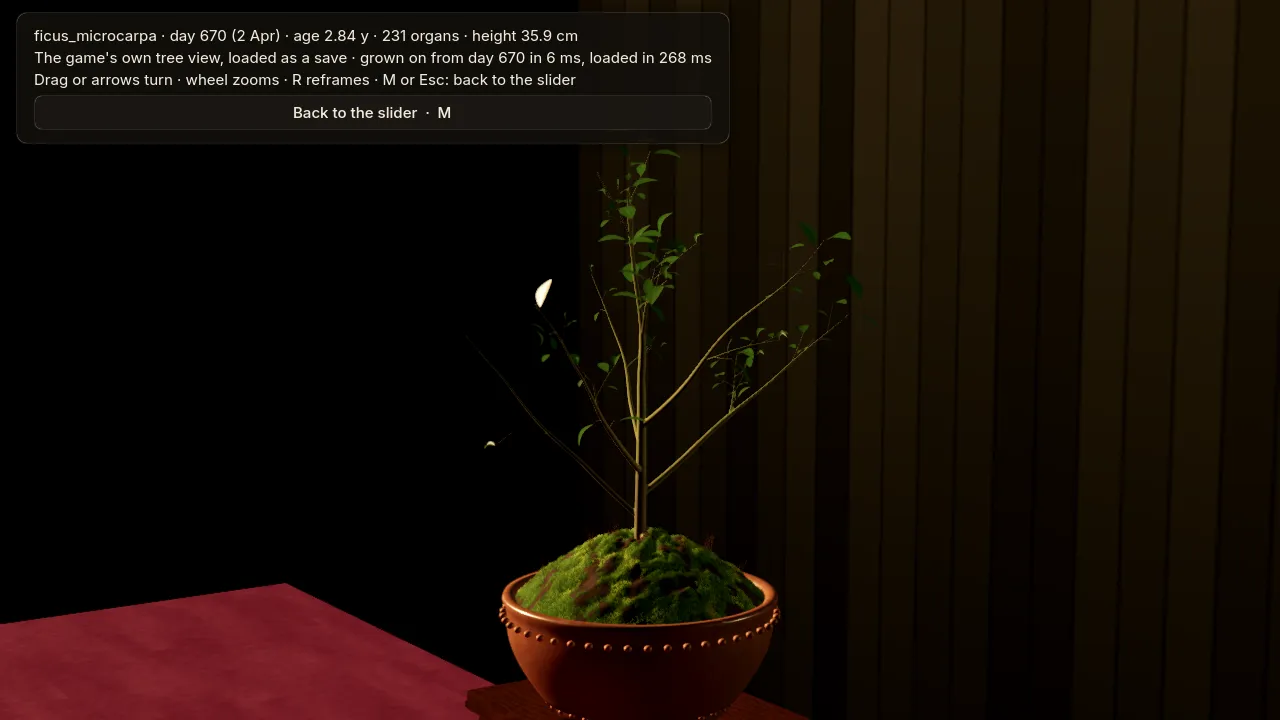
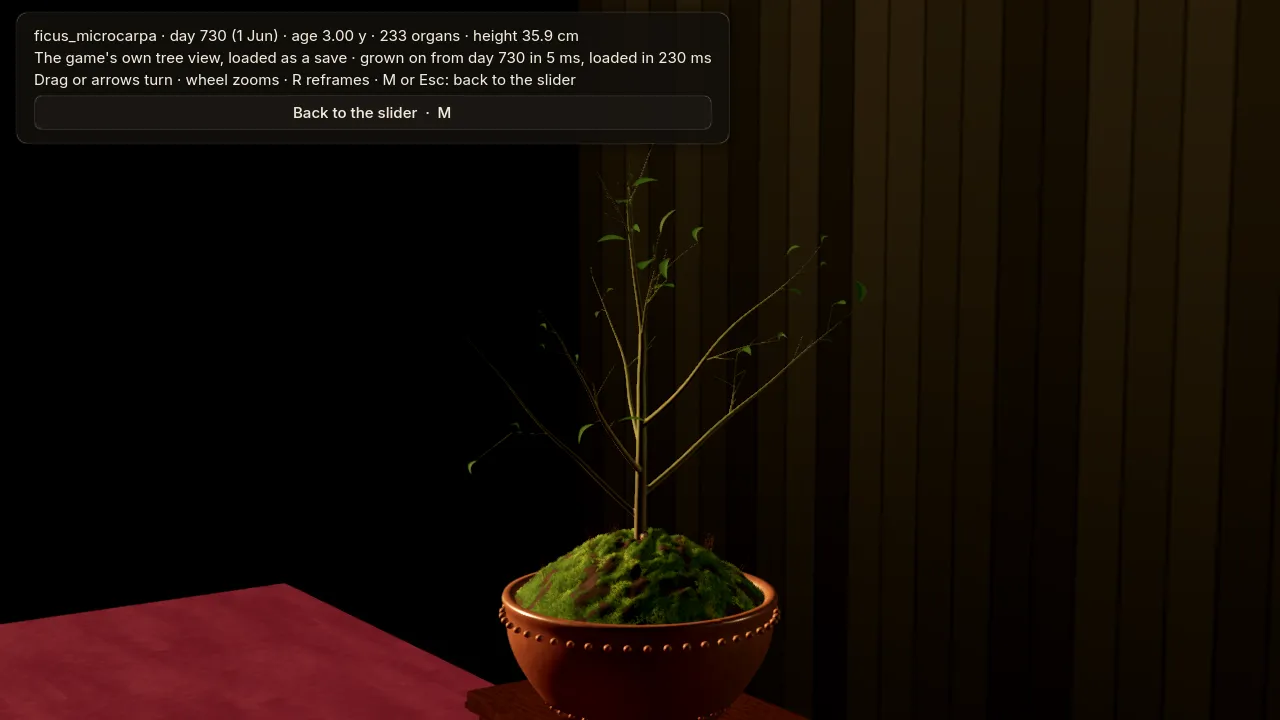
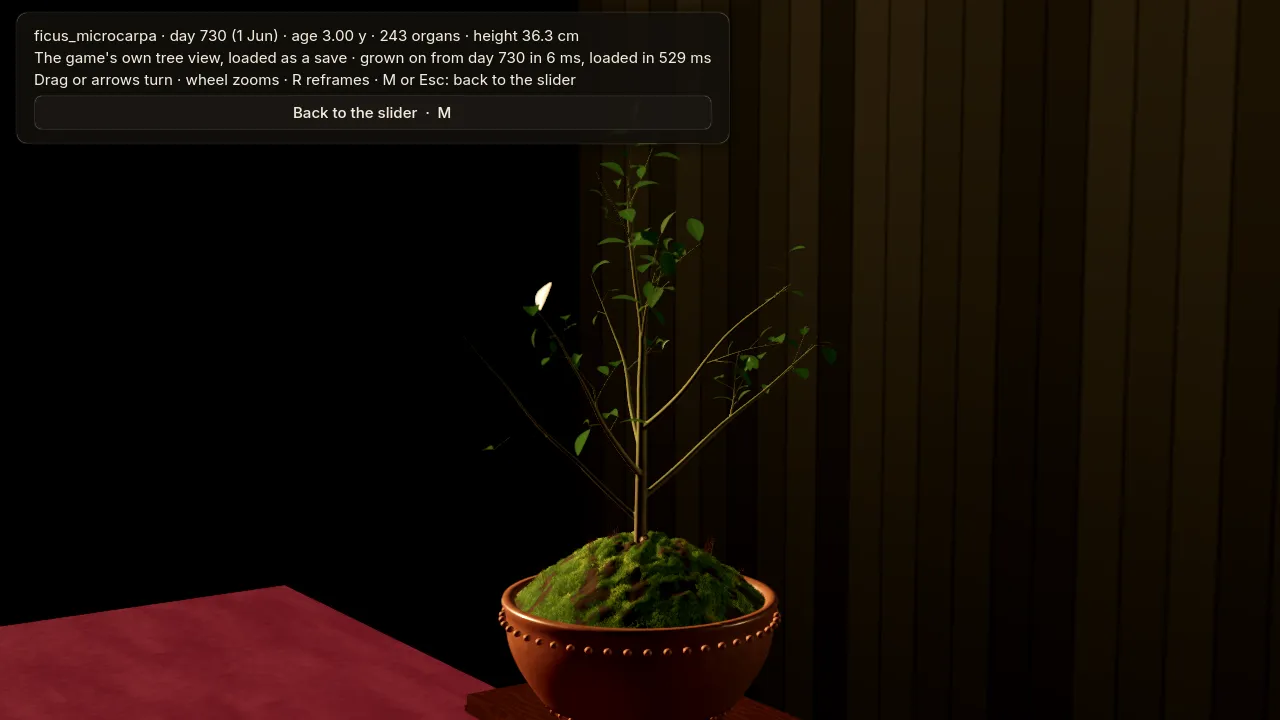
The first version let a leaf start waiting at 0.7 of its life. Measured, that went wrong somewhere I had not looked: a growing tree makes a new leaf almost every day, so every leaf fell the day it reached 168 days, the crown carried 30 % fewer leaves and the develop routine grew 8 % less. Opening the gate at the full life keeps growing trees exactly as they were (298 shoot segments against 299 for the develop routine) and still holds the winter crown.
A store that pays for regrowth
The refine tree had a second problem: its carbon store was full and it could not spend it, because the store's size and the growth budget both followed the leaves it still carried. Research says trees keep 80 to 97 % of their stored carbon in wood and roots, keep it for years, and spend it on new leaves after a loss, at up to about 1.5 % of the store a day and as fast as their buds allow.
So a tree now remembers the leaf area it has lost and not grown back. The store keeps the size the tree had before, and while that debt lasts it pays for extra shoots, keeping half for an ordinary loss and going deeper only when the tree is nearly bare. New leaves pay the debt back, and it fades over about a year.
| A ficus stripped on 15 June | Leaf area at 6 weeks | 12 weeks | 20 weeks |
|---|---|---|---|
| The store pays for regrowth | 37 % | 43 % | 55 % |
| The rule before | 34 % | 38 % | 47 % |
| Its unstripped twin | 100 % | 100 % | 104 % |
The stripped ficus has as many leaves as before by eight weeks (115 %), which matches growers' five to seven weeks. Its leaf area lags because the first leaves of a regrowth are small, which is why growers strip a ficus. The store pays for the regrowth down to 22 % of what it held; seedlings starve below about 20 %. My first test expected 80 % of the leaf area back in five months, a figure from burnt saplings regrowing whole shoots. A strip makes small leaves on purpose, so the test now asks for the leaf count, for more area than the old rule, and for at least the 31 % an aspen's single regrowth reaches.
A cherry is not a fig
The potted cherry had been flagged as slow: 16 to 29 cm in its first summer, against nursery cherries that stand three quarters of a metre after a year in the ground. Before reading anything I grew the cherry, ficus and juniper side by side and logged what limited each, day by day. The model's cherry was its ficus on every day it grew: the same 13 mm internodes, the same small leaves, the same growth per leaf and the same light. It only had a shorter season. And for every species the brake was the same: a shoot may only reach so far beyond its own thickness, so after nine weeks most carbon went into thickening shoots that were waiting to lengthen.
Two more research passes gave the cherry its own shape. Its long shoots have internodes of 2.5 to 4 cm, a one-year whip stands about a hundred times its stem's diameter, and it does almost all its lengthening in the two to four months after bud break, then sets its buds and thickens. Now a cherry's new shoots take 25 mm internodes, may reach 100 times their diameter, grow in full for 80 days after leaf-out and fade to a tenth by 125. The growth it no longer makes goes into thickening the shoots that held it back, and its store keeps its size through the winter for the spring flush.
| The nursery cherry | Before | Now | What the research found |
|---|---|---|---|
| First summer in the pot | +8.2 cm | +11.6 cm | +10 to 40 cm |
| Second season's growth within 120 days of leaf-out | 53 % | 83 % | almost all |
| Second season's new shoot | 0.99 m | 0.93 m | 0.5 to 2 m |
| Grown out, two years | 38.1 cm | 47.3 cm | 80 to 150 cm by year three, repotted and fed |
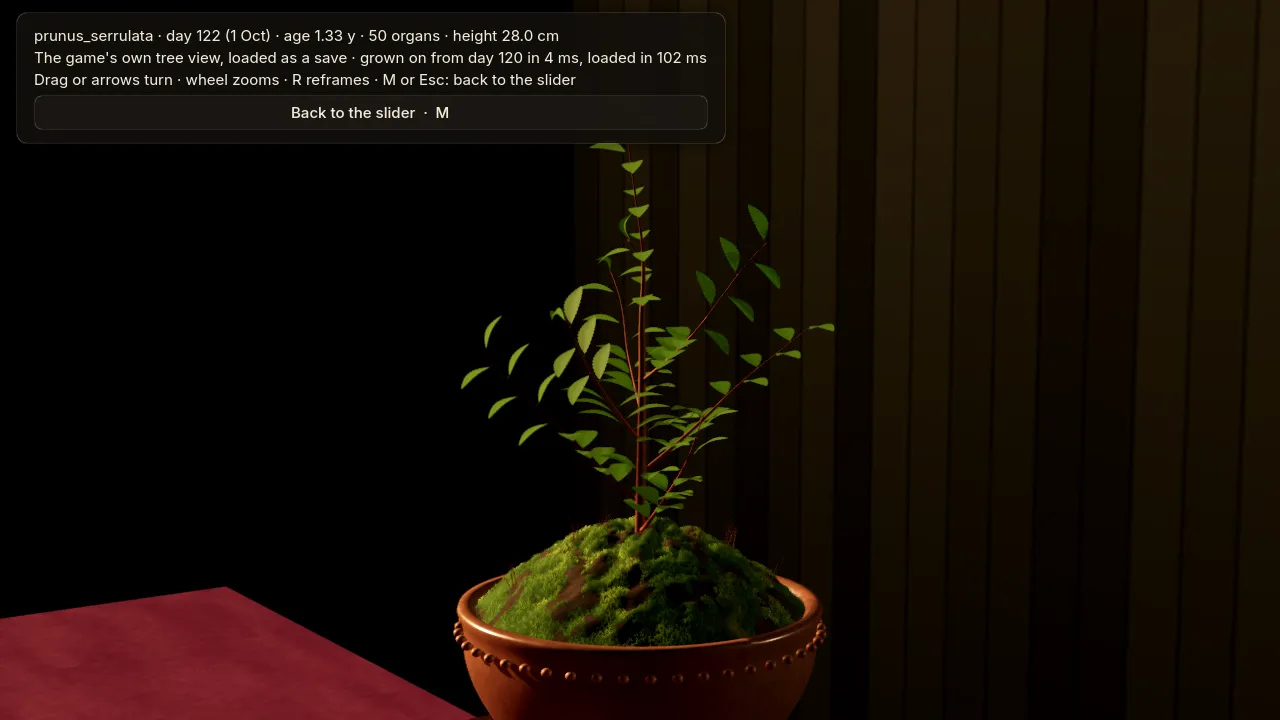
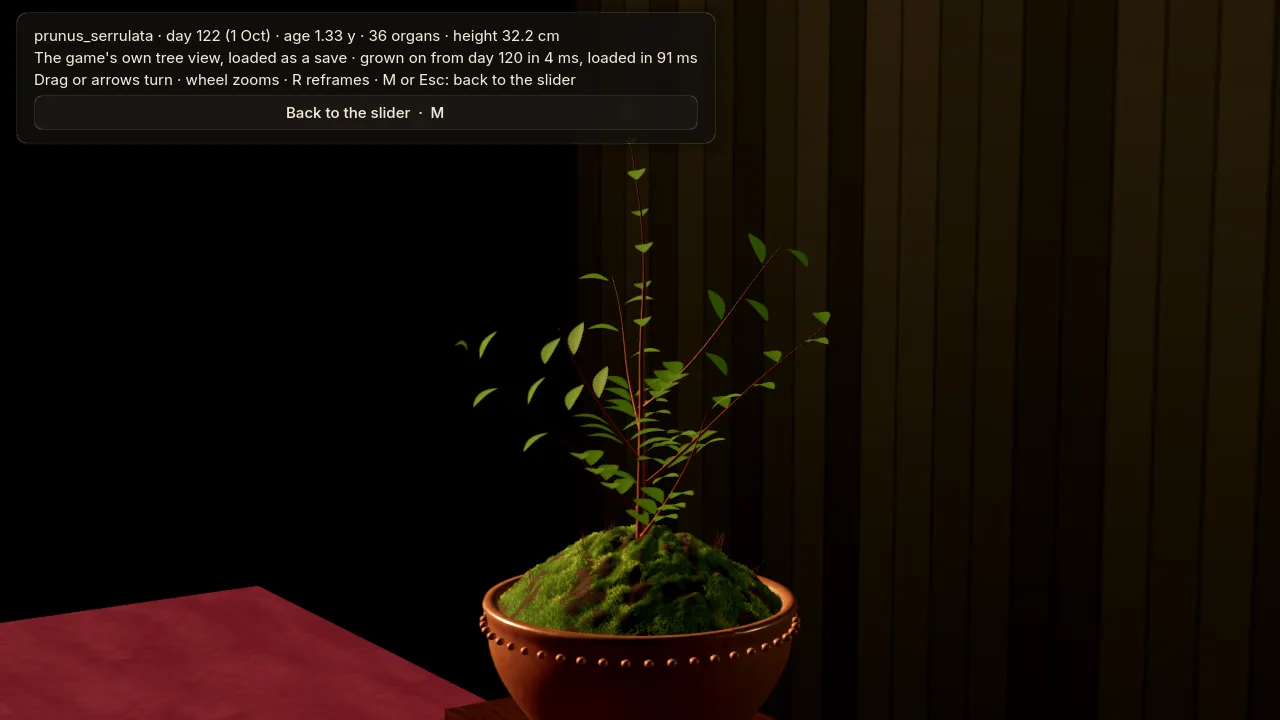
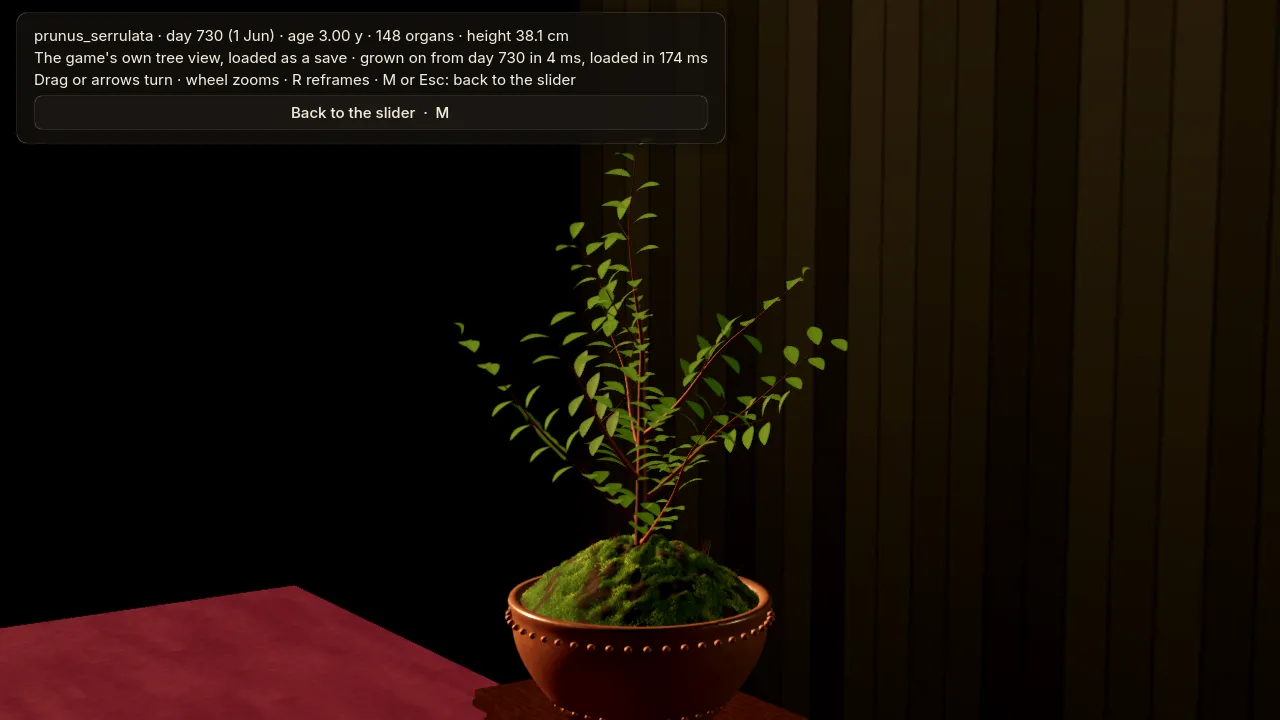
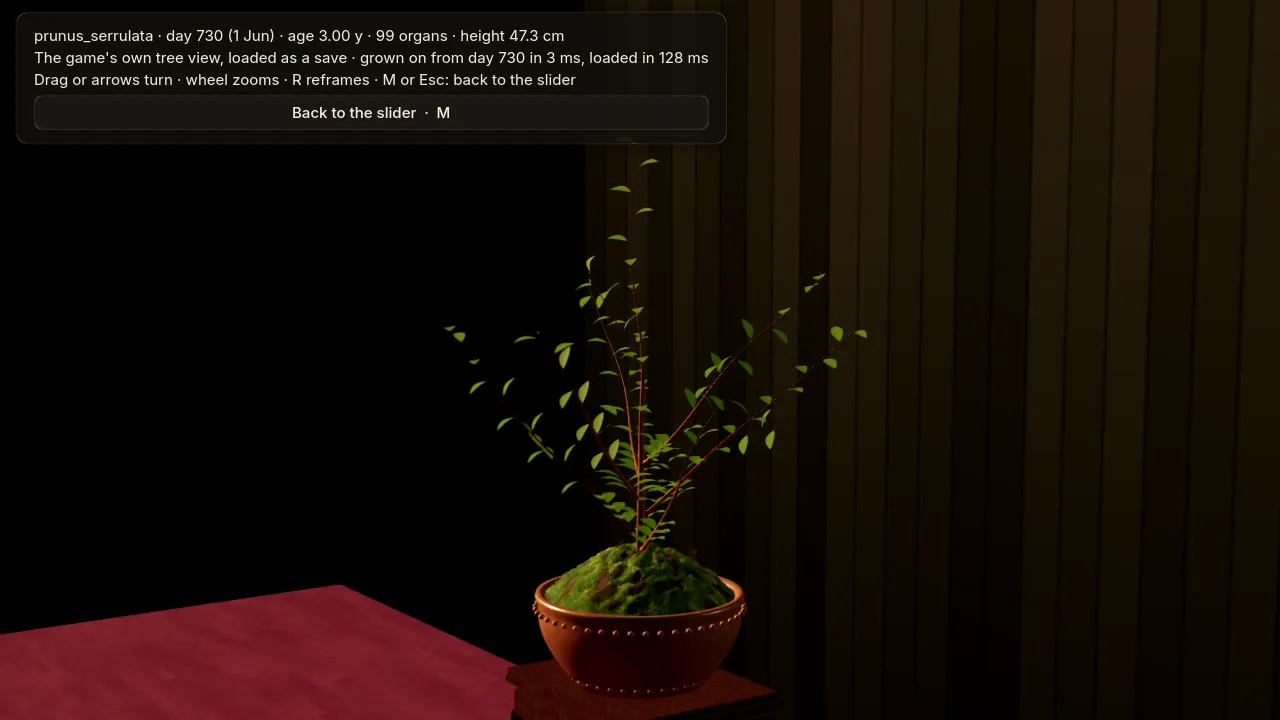
The season window alone made things worse: growth stopped in July, the carbon had nowhere to go, the store filled and photosynthesis stopped. Sending that carbon into the wood is what turned it into a gain. One small oddity stays: in its first October the new cherry adds about 20 cm of shoot across the tree, because the late thickening frees its shoots while a tenth of normal growth is still allowed. Leaf counts in these captures include fixed foliage points on the nursery stock.
Why the cherry is still short
A real pot-grown cherry reaches 80 to 150 cm by its third year. The model's reaches 47. The reason is the model's leaf: every species has the same small leaf, about 1.3 cm², where a cherry leaf is 30 to 45 cm². So a cherry node earns about a thirtieth of the carbon its real leaf would, while the wood a long shoot needs costs its real weight: a 50 cm shoot on a 5 mm base is about 2 g of wood. Giving the cherry its own leaf would rebuild its whole carbon economy (roots, water, light and the store), so it is a design decision of its own rather than a quiet fix.
What's next
- Decide whether the cherry gets its own leaf size and node cost, the rest of its height gap.
- Add wiring to the grower routines, since young junipers and figs are wired while they are whips.
- Review the Early Access list: pruning, pots, seasons and the sounds of care.
What I learned
Measure a new rule on the common case, not only the case that failed. The leaf-replacement gate was drawn for one crown whose leaves all fell together, and at its first setting it quietly shortened the life of every leaf on every growing tree. And before tuning a species, measure what actually limits it: the slow cherry turned out to be a fig with a shorter year, held back by a brake every tree shares.
Sources & development context
Based on House of Bonsai's source history and notes from 11 to 12 October: the check runner's records (runs 20261011-221604 to 20261011-233625), the growth slider's reports and captures (windowed runs at 1280 by 720 on the development PC), the vigour probe, and the project's growth research log, sections 11 and 12 (97 sources), for reserves, leaf lives, regrowth and cherry growth. Model outputs, not field measurements; no package has been built since dev.42.