
The same file, the same tree
The mesh fingerprints that proved the last loading speed-ups exact also caught an older bug: the same save could draw two slightly different trees, depending on what had been loaded before it. One joint lost its bark collar, 32 triangles out of four million. The cause was order, not geometry. Dead wood stripped along two grown branches (a jin) was applied to their editable copies after the view around them had been fitted to the old shape. Each copy now takes its jin before it is first built, and every load gives the same fingerprint. The courtyard also stopped rebuilding trees that had not changed: stepping back out of close care with the large test juniper went from 15.3 seconds to 1.4.
Checks that ask for what they need
Every check now runs through one runner with a dashboard, and its first full pass found 34 of 46 passing. Most failures had one cause. Two weeks earlier, branches had been limited to what their wood can hold, which slowed young growth three- to fourfold on purpose, and the older checks still waited a fixed number of days for a branch long enough to test. They now grow the tree until the state they need exists, and the full suite passed 46 of 46. One check had never asserted anything at all. The runner now fails whenever a test exists that it does not run; an audit had found fifteen.
Why the tree stopped at a metre
A program that took a seedling through every tool in the game, wiring, cutting, pinching and shearing, and then planted it in the courtyard, ended with a knee-high shrub. Lifting the growth graph’s 2,048-organ limit fourfold gave a 98 cm tree: height followed the logarithm of the organ count, about ten centimetres per doubling. Teaching the model where its organs are, so leaves could shade each other, changed almost nothing, because the open young crown had nothing to compete for. Asking the leader directly what stopped it named the rule: a shoot may only reach sixty times its own diameter, and every tip thickens from one shared pool of wood, so each doubling of the tree buys the leader one tip’s worth of height. A model built from 13 mm internodes cannot grow a large tree in a bounded budget.
Two models, one tree
So a tree planted in the ground now changes models. The detailed model stays the bonsai model, and the lifecycle tool’s annual model, which grows a fig to 14 m in 10 cm segments, takes over in the ground. The translation failed when it was literal: a bonsai crown is far denser than anything the annual model grows itself, so every tip started in total shade, and the tree stood still for a year and a half and shed a third of itself. The foliage now crosses as the annual model’s own unit of light, and a cut end with a live shoot below it crosses as a relayed apex. In the game, a planted tree’s save keeps the bonsai as it was planted and the tree grown since; at the moment of planting, 2,090 leaves land within 0.35 mm of where the bonsai drew them. A planted fig reaches 7.1 m in ten years and 11.4 m in forty. Planting a juniper showed that the 3D view had only ever been checked on figs: it drew fig blades on a juniper. Each species now draws its own foliage.
Keeping a large tree in scale
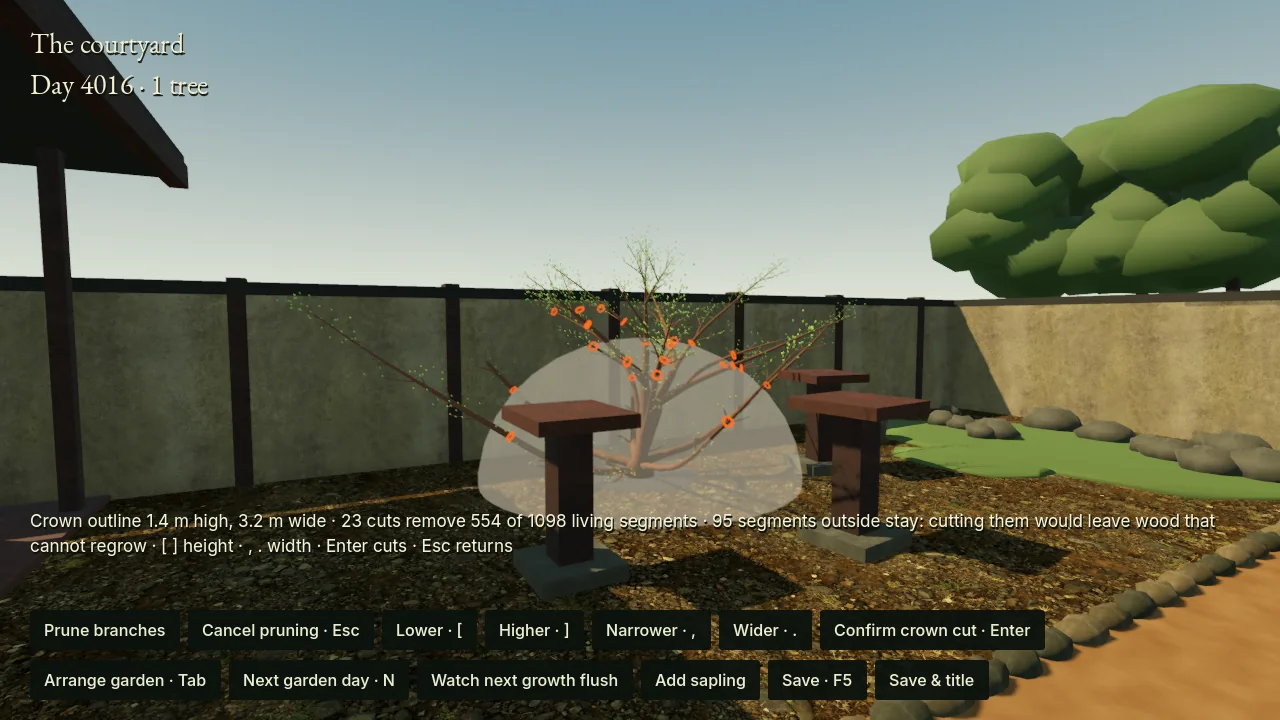
Japanese gardens keep large trees in scale by pruning them, and the courtyard can now do the same. Select a planted tree, choose Prune branches and click a branch to see where the cut falls; Reduce crown shows an adjustable dome with a ring at every cut it would make, and Undo works until the next garden day. A cut wakes the latent buds below it as the species allows: a fig buds back from old wood, a juniper never from bare wood, a cherry only from young wood. A fig trimmed every year held 3.45 m for ten years where an untrimmed one reached 7.1 m. The juniper needed a second rule. The first allowed a cut wherever leaves stayed below it, and a juniper trimmed that way looked fine for three years and lost half its height in the fourth, when the last needles on stubs that could never grow again fell. A juniper is now trimmed only in growth that can still grow, so it stays a little larger than its outline. Watch next growth flush advances the whole garden to a tree’s next flush, with no automatic care.
The pot, under test
Back in the pot, the Early Access plan asks pruning to produce useful choices and credible recovery. Before changing anything, eight histories started from the same young fig, juniper and cherry: left alone, the leader cut, new shoots cut back to two leaves again and again, one low branch left to grow as a sacrifice, and a hard cut to a 16 cm stump. The cut-back crown had twice the untouched tree’s leaf area per volume of crown. Everything else showed a gap. Nothing replaced the cut leader: the highest shoot was a side branch at 44 degrees. The sacrifice branch did nothing for the trunk (45.8 mm against 45.9 without it). And over-pruning cost nothing: the stump, with 5 per cent of its leaves, regrew to three quarters of the untouched tree’s leaf area in 40 days, doubled its roots and ended with a thicker trunk. The cause is one line: growth is capped at 24 mg of carbon a day however many leaves the tree has, and the rest is banked, 7.2 kg of it on a 71 cm tree.
Teaching the cut
The first fixes landed on October 4. The first bud a cut wakes on the cut branch’s own line now takes that line over: it leaves at a shallow angle (about 11 degrees in the check, where a side branch leaves at 30 to 52), keeps the line’s vigour, and turns back toward the line’s heading as it grows. Buds follow the same species rules as the courtyard: a bud still alive at its age breaks, and an older one only near the cut, a fig’s within 0.6 m on wood up to 30 years old, a cherry’s within 0.3 m on wood up to two, a juniper’s never; a fig also buds again where a side shoot was lost. A stub left above its node dies back to the node three weeks after the cut, and a juniper side branch cut into bare wood dies whole and turns to deadwood. All of this is in the development source, not yet in a build, and the eight histories are being run again against it. Over-pruning is next: growth that the remaining leaves have to pay for.
What I learned
Ask the thing that is stuck what is stopping it: the plausible cause, too little light, was real but was not the limit. When two models meet, translate what each means by a word like leaf or cut, not just the numbers. And when a model never punishes a mistake, look for the budget that never runs out.
Sources & development context
Based on House of Bonsai’s source history and notes from the evening of September 26 to October 4: the check runner’s records (full suite 46 of 46 on September 27; quick suite 32 of 32 on October 4), the growth-ceiling and light probe reports, the handover and annual-ground checks (leaf match within 0.35 mm), the garden-pruning check and the yearly-upkeep program, and the EA-07 pruning-history runs. The pruning histories and upkeep programs run growth at the 250x test rate with watering assistance; they are development experiments, not normal play, and courtyard heights are model outputs, not field measurements. Timings come from one development machine (Intel Core Ultra 9 185H with an RTX 4070 Laptop GPU). No new standalone package has been built since dev.39, which is not a public download.